Electronics

Kindle

Sunday, September 11, 2011

The day Idi Amin wanted to annex western Kenya


Former Uganda’s President Idi Amin Dada chairs the 12th Organization of African Unity (OAU, OUA) summit in August 1975 in Kampala. Picture: AFP
The dispute between Uganda and Kenya regarding the ownership of Migingo Island in Lake Victoria rekindles memories of another dramatic flare-up in 1976, when Ugandan President Al-Haji Field Marshal Idi Amin Dada attempted to redraw the boundaries of the two count

Migingo among other border disputes

Land dispute threatens RVR concession
Amin wanted back all Kenyan districts that were part of Uganda before the colonial re-demarcation of the territorial boundaries. These included Turkana, part of Lake Rudolf (now Lake Turkana), West Pokot, Tranz-Nzioa, Bungoma, Busia, Kakamega, Central Nyanza, South Nyanza, Narok, Kisii, Kericho, Nakuru, Uasin Gishu, Elgeyo, Marakwet, Nyandarua, Nandi, Kisumu, Eldoret, Tambach, Maji Moto, Maji Mazuri, Gilgil, Nakuru, Lake Baringo and Naivasha.

He claimed that these areas were very fertile and produced nearly all the wealth in Kenya.
He backed down only when President Jomo Kenyatta threatened to block Uganda’s imports through the port of Mombasa.

Past geography

While opening the Lotuturu Self-help Mobilisation Scheme, 83 kilometres north of Kitgum in East Acholi District of northern Uganda on February 14, 1976, president Amin issued a statement in which he claimed he was informing the people of Uganda about their past geography.

The Voice of Uganda newspaper edition of February 16, 1976, reported that Amin directed that every Ugandan should buy a pamphlet, that was being published, detailing the boundaries of the country.

He said Uganda’s borders were beyond Juba and Torit in the Sudan and all areas of western Kenya, up to about 30 km from Nairobi.

Following the scramble and partition of Africa by imperial powers in 1884, Uganda fell into the British sphere of influence. Uganda was later divided into six provinces in 1902.

These were: Rudolf Province, which included the Turkana and Karasuk; Eastern Province, which included Nandi, Kavirondo, Eldoret, Naivasha, Maasai, up to the border with Tanzania; Central Province, which included Karamoja, Sebei, Mumias, Busoga and Bukedi; Buganda Province, which included Entebbe, Masaka, Kampala, Bugangaizi and Buruli; Nile Province, which included the whole of the present Nile Province, Lango, Acholi, Juba, and Baragazalo which is about 600 miles away from Kampala; Western Province, which included Rwenzori, Boga, Hoima and Masindi.

“In order to educate the public mind of all the sections of Uganda, I also promised that I will be providing geographical and historical facts as documented by the British colonial administration on the transfer of Uganda’s lands thereby affecting its boundary,” Amin wrote in his book titled, The Shaping of Modern Uganda And Administrative Divisions, published in 1976.

“In stating this, I had in my possession a document indicating that with the appointment of Sir Harry Johnson, the British government gave a clear mandate for this Special Commissioner to arrange and reorganise the internal administration of Uganda including its external boundary, particularly in the British sphere of influences which Johnson did from 1st July, 1899 to December, 1901,” Amin added in the book published by the defunct Government Printer in Entebbe.

“Uganda’s boundary outside the British sphere of influence was still a matter being debated in European capitals. However, Britain knew that certain land-marks such as the watershed of River Nile and the Congo in the northwest and the whole floor of Western Rift Valley including Mufumbiro Mountains lay in the British sphere and it only required actual survey on the ground,” Amin argued.

Assuring his neighbours, Amin added: “There was no intention of Uganda claiming an inch of any territory of her neighbours, whether Kenya, Sudan, Zaire (Congo), etc. As a firm believer in OAU [now AU] and as its Chairman, I know of the OAU July Resolution of 1964 which ‘solemnly declares that all member states pledge themselves to respect the borders existing on their achievement of national independence.”

Noble objectives
“In order to make Ugandans understand the noble objectives, I consider it necessary to explain to them their past recorded geographical and historical connections as before the partition of Africa by imperial powers at the Berlin Conference of 1884, the African nations knew of no national boundaries although after the attainment of independence, through blood and sweat, Africans knew of their boundaries. All of them had blood relations across their borders,” Amin wrote.


Migingo among other border disputes
Land dispute threatens RVR concession
Stressing that he was informing people without any intentions for war nor advocating any changes, Amin said he had a written agreement signed by the then British colonial secretary of state Herbert Asquith, transferring some parts of Uganda to Sudan in 1914 and to Kenya in 1926.

Had the colonial British administrators not given away some of Uganda’s soil, Juba and Torit in South Sudan, the whole of the Rift Valley Province and northwestern Kenya would today be Uganda.

Insisting that the British would have to answer for transferring certain areas of Uganda to Sudan and Kenya, Amin said nearly the whole of South Sudan from Nimule, Juba, Gondokoro and the area around Torit, which extends right up to the present-day border with Ethiopia, was under the administration of Uganda until 1914 when it was transferred by the British colonialists by the order of secretary of state under 1902 Uganda Order in Council.

The area just north of Kitgum after the Uganda/Sudan border was Uganda’s territory until 1927. Nile Province had been transferred to Sudan in 1910 by the British and it was not until 1914 that Nile Province was transferred back to Uganda.

Amin argued that the British colonialists made several mistakes when they were making territorial demarcations.

Amin said that God was not a fool to have allocated this land to Uganda and wondered why the British did not transfer other areas that were not fertile.

He said the fact that the area the British transferred to Kenya from Uganda was one of the most fertile areas in East Africa would be enough to provoke him to go to war to reclaim the land but he would not do that because he was a leader who wanted peace to prevail in the world, Voice of Uganda reported.

If, however, the people in these areas, which were transferred to Kenya, were not happy with the administration, they should be allowed to have their own government.
Amin said that his duty as the supreme commander of the Uganda Armed Forces was to liberate all Uganda’s territories. He said this was also part of Field Marshal Amin Operation to Correct Mistakes Made by the Britons.

Amin stated that he had no intention of going to war with any country, warned that Uganda being a land-locked country, if any country interfered with the transportation of her imports and exports to and from the sea, that would provoke him to go to war.

Amin said he would always speak the truth and feared nobody except God, Voice of Uganda reported on February 21, 1976.
Amin said when he declared the Economic War in 1972, he promised that he would correct all the mistakes made by the British. He added that the British knew he was telling the truth.

Dispute with Sudan

Uganda has had other boundary disputes with its neighbours.

In 2005, Sudan claimed a five-kilometre stretch of customary boundary from the Madi and Aringa people in northwestern Uganda.

The Sudanese accused the Madi of Moyo and Yumbe districts in Uganda of extending their administrative structures inside their land.


Migingo among other border disputes

Land dispute threatens RVR concession
In 2009, tensions rose when the Congolese began building a police post in a contested area near the Ugandan Customs point at Goli, along the Uganda-DR Congo border in Nebbi District of West Nile.

The police post was being built within 50 metres of Goli, which Uganda considered a buffer zone. This caused unnecessary anxiety since the area is among those the two countries agreed to verify the location of through a Joint Permanent Commission.

Earlier in 2008 the Congolese had caused another controversy when they shifted their border point from five kilometres to within 200 metres of the Ugandan crossing point at Vurra in Arua District of West Nile. This was one of those areas to be decided upon by the Joint Permanent Commission.

Floating island

Uganda and Congo also have a dispute over the ownership of Rukwanzi Island, a “floating island” in Lake Albert. The recent discovery of oil under Lake Albert exacerbated the territorial dispute over the ownership of the island. The 12 square kilometre area is home to about 3,000 people, mostly fishermen.

Troops from Uganda and the DR Congo exchanged gunfire near Rukwanzi Island in August 2007, leaving several people dead, including a British contractor who worked for an oil company.




Friday, August 26, 2011

Nato joins attack on Gaddafi bastion

The BBC's Paul Wood on the road to Sirte as rockets are fired at Gaddafi loyalists

The BBC's Paul Wood on the road to Sirte as rockets are fired at Gaddafi loyalists

Continue reading the main story

Libya CrisisLibya fighting

Live

Where is Col Gaddafi?

Who might lead after Gaddafi?

Tripoli resident: Wary of snipers

British Tornado jets fired precision-guided missiles against a large bunker in Libyan leader Col Muammar Gaddafi's hometown of Sirte, the UK Ministry of Defence (MoD) has said.

The Tornadoes took off from RAF Marham in Norfolk on a long-range strike mission on Thursday night.
Libyan rebels are also building up their forces on the road to Sirte, sending tanks and rocket launchers.

Rebel leaders have appealed to foreign governments to unfreeze Libyan funds.

The UN has already agreed to release $1.5bn (£1bn) in Libyan assets - which had been frozen under sanctions - to help with immediate humanitarian needs.

Closing in

In a statement, the MoD said "a formation of Tornado GR4s... fired a salvo of Storm Shadow precision-guided missiles against a large headquarters bunker" in Sirte.


Defence Secretary Liam Fox:

The bunker housed a command and control centre. There is no indication that Col Gaddafi was in Sirte or in the bunker itself at the time of the attack.


Defence Secretary Liam Fox: "The Nato mission remains the protection of the civilian population"
"It's not a question of finding Gaddafi, it's ensuring the regime does not have the capability to continue waging war against its own people," Defence Secretary Liam Fox told the BBC.

"The attack that we launched on the bunker in Sirte last night was to make sure that there was no alternative command and control should the regime try to leave Tripoli."

Nato warplanes also targeted 29 vehicles mounted with weapons near Sirte and bombed surface-to-air missile facilities near Tripoli, the alliance said at a daily briefing in Brussels.

Meanwhile, the rebels are building up their forces around the town of Bin Jawad, preparing for an assault on Sirte, about 100km (60 miles) to the west.

The BBC's Paul Wood, who is with the rebels, says their mood is still buoyant, despite running into unexpectedly stiff resistance.

Rebel commanders think the fighting on the road to Sirte could last another three or four days, our correspondent says.

The rebel administration, the National Transitional Council (NTC), has begun moving to Tripoli, although many senior figures remain in the eastern stronghold of Benghazi.

Speaking in Istanbul, the head of the rebel government, Mahmoud Jibril, said the uprising could fall apart if funds were not forthcoming quickly.

"The biggest destabilising element would be the failure... to deliver the necessary services and pay the salaries of the people who have not been paid for months," he said.

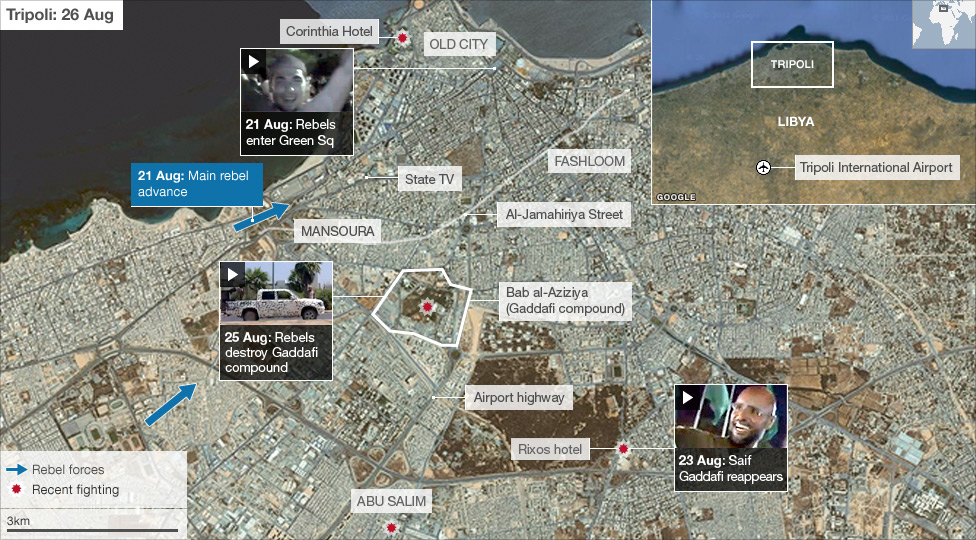
In the Libyan capital, Tripoli, there is continued fighting in the Abu Salim district, one of the last areas loyal to Col Gaddafi.

A Scottish nurse working at the hospital in Abu Salim, Karen Graham, told the BBC they were "overwhelmed" with casualties.

"All the staff were just doing the best we can, but we were literally inundated," she said. "We'd just clear one lot of casualties and the next lot would be getting brought in. Our theatre just couldn't cope... This is the first time we've had such a vast number of people in."

Human rights group Amnesty International says it has evidence that both pro-Gaddafi forces and rebels abused detainees in their care.

Guards loyal to Col Gaddafi raped child detainees at Abu Salim prison, Amnesty said. It also accused rebels of beating prisoners, including a boy conscripted by Gaddafi forces who surrendered to the rebels at Bir Tirfas.

Summary executions

The UN is to investigate reports of summary killings and torture through its existing commission of inquiry on Libya.

"We urge all those in positions of authority in Libya, including field commanders, to take active steps to ensure that no crimes, or acts of revenge, are committed," UN spokesman Rupert Colville told Reuters.

The UN has previously said some military action in Libya could amount to war crimes or crimes against humanity.

The BBC's Rupert Wingfield-Hayes visited a hospital in the Mitiga district of Tripoli which had received the bodies of 17 rebel fighters.

Doctors said the group had been prisoners of Gaddafi troops in Tripoli and were tortured and killed as the rebels seized the capital earlier this week.

Dr Hoez Zaitan, a British medic working at the hospital, said about half the bodies had bullet wounds to the back of the head while others had disfiguring injuries to their limbs and hands.
He said the bodies had been examined for possible evidence to be used at a war crimes tribunal.


Wednesday, August 24, 2011

Strauss-Kahn New York sexual assault case dismissed

A New York judge has dismissed the sexual assault case against former IMF director Dominique Strauss-Kahn

The move came as prosecutors cited doubts over the credibility of his accuser, 32-year-old hotel maid Nafissatou Diallo.
Mr Strauss-Kahn, 62, was accused in May of attacking the African immigrant as she entered his hotel room to clean it.
The ruling means he is a free man, though he still faces a civil suit Ms Diallo filed this month.

"Our inability to believe the complainant beyond a reasonable doubt means, in good faith, that we could not ask a jury to do that," Assistant District Attorney Joan Illuzzi-Orbon told Judge Michael Obus.

'Hurried sexual encounter'

The dismissal of criminal charges at the New York State Supreme Court will take effect once the judge rules on an appeal against the move.

Mr Strauss-Kahn, considered a French presidential contender before the case, arrived for the hearing in lower Manhattan on Tuesday in a six-car motorcade with his wife Anne Sinclair.

Outside, about two dozen placard-waving protesters denounced the result, their cries audible from the packed courtroom on the 13th floor.


Outside court a noisy group of demonstrators - mostly feminists and socialist activists - urged the judge not to drop the case. "Another rich powerful man gets away with whatever he pleases," read one banner.


Amid the chanting, a lone voice shouted, "she's a liar, she's a liar". It came from an African woman in a black cloak and headscarf. Brandishing a signboard that questioned in lurid detail Nafissatou Diallo's virtue, the woman claimed Mr Strauss-Kahn's accuser, an African immigrant, had tried to frame him.

In fact, prosecutors asked for the charges to be dropped not necessarily because they believed the former IMF head to be innocent, but because they had lost confidence in the hotel maid's credibility. Mr Strauss-Kahn looked pleased, but not jubilant, and gave his wife a small smile.

The combustible mix of sex, race and class presented by the case has particular resonance here. With a civicase now pending, interest will probably rumble on in America if not in Europe.

Ms Diallo claimed Mr Strauss-Kahn had confronted her in his luxury hotel suite in the city on 14 May and forced her to perform oral sex.

Prosecutors said DNA evidence had found that a "hurried" sexual encounter did occur between the two, but it did not establish Ms Diallo's claim that it was non-consensual.

In a statement released by his legal team on Tuesday, Mr Strauss-Kahn said: "These past two-and-a-half months have been a nightmare for me and my family.

"I want to thank all the friends in France and in the United States who have believed in my innocence, and to the thousands of people who sent us their support personally and in writing.

"I am most deeply grateful to my wife and family who have gone through this ordeal with me."

He added: "We will have nothing further to say about this matter and we look forward to returning to our home and resuming something of a more normal life."


Rush to judgment'

Outside the court on Tuesday, Mr Strauss-Kahn's lawyer, William Taylor, accused the media, police and prosecutors of a "collective rush to judgment".

Protesters chanted slogans and waved placards outside the court


I want to remind you how uncritically the media examined this case from the beginning without even looking at the improbability of the story on its face," he said.

In court papers filed on Monday, Manhattan prosecutors said they did not feel at ease pursuing the case, citing deep concerns over Ms Diallo's credibility.

Protesters chanted slogans and waved placards outside the court She "has not been truthful on matters great and small" and has an ability to present "fiction as fact with complete conviction," they wrote.

Medical and DNA evidence, meanwhile, was "simply inconclusive" as proof of a forced sexual encounter, they added.

Mr Strauss-Kahn's was forced from his job as director of the International Monetary Fund after his arrest on board an Air France jet in May.

But within weeks, prosecutors said there were inconsistencies in Ms Diallo's accounts of the alleged assault and of her background.

It was revealed that she had been recorded discussing the case with a jailed friend and appeared to refer to Mr Strauss-Kahn's wealth, which his supporters said pointed to a financial motive.

Prosecutors also said Ms Diallo had not been truthful in tax documents, nor on an asylum application form in her account of a gang rape she said she suffered back in Guinea.


Ms Diallo's lawyer said on Monday that she had been denied justice

AdvertisementMs Diallo's lawyer said on Monday that she had been denied justice

Mr Strauss-Kahn was later freed from his restrictive bail conditions.

Ms Diallo then took the unusual step of giving media interviews, defending her allegations against him, and on 8 August, she filed a civil suit against Mr Strauss-Kahn.

The Frenchman's legal travails are not yet over: authorities in Paris are still considering whether to press charges against him over a claim by French writer Tristane Banon that he tried to rape her during a 2003 interview.

Ms Banon made the allegation after the Diallo case, saying that she feared no-one would have believed her beforehand.

Monday, July 25, 2011

You don’t wait for war to buy fighter jets, says Gen. Museveni

One of the new Russian-made jet fighters prepares for a demonstration take-off during President Museveni’s tour. PHOTO BY MARTIN SSEBUYIRA                


Entebbe
The Commander-in-Chief of the Armed Forces, Gen. Yoweri Museveni, yesterday conceded calls by opposition for the government to give priority to infrastructure and healthcare ahead of military hardware are plausible but said defence cannot wait for war to purchase equipment.
Mr Museveni, who was inspecting the new planes at the airbase in Entebbe, said the delivery of Sukhoi Su-30 multirole fighters was after a long procurement process. He said he travelled to Russia last year to visit the factory that manufactured the newly-acquired fighter jets that cost government Shs1.2 trillion. He equated the long procurement process of the jets to the procedure a buyer goes through before a tailor finally makes clothes.
“In the 1950s, people had two options when walking in a shop to buy clothes; either to buy the available clothes or be measured by the tailor to make new clothes. I travelled to Russia in August last year to be measured and got brand new planes whose fruits are being seen now,” Mr Museveni said.
He acknowledged the calls by the opposition to build roads, schools and hospitals instead of buying military hardware but said military equipment is not procured during war times. “You don’t wait for war to buy military equipment in security. It’s normally advisable to buy when there is no war,” he said.
Opposition lawmakers have described the procurement as illegal, and accused the government of draining the central bank’s reserves without parliamentary approval.
The purchase of the jets has also been criticised by technocrats, including Bank of Uganda Governor Tumusiime Mutebile. Mr Mutebile in June told the UK’s Financial Times newspaper that he had disagreed with the President over the purchase of fighter jets. But the President said the jets will beef the security capacity of the UPDF. He said the army relied on the M16 helicopters to end the LRA war.
The Russian-built Sukhoi SU-30 jet fighter is a twin-engine, all-weather aircraft, which can be deployed in air-to-air and air-to-surface missions. It can undertake combat missions within a 3,000-kilometre range, affording the UPDF the legroom to strike distant targets with precision and efficiency.

Friday, July 1, 2011

Libya: How U.S. And Moreno Ocampo Destroyed The ICC

Ocampo--The ICC's chief prosecutor has single-handedly destroyed the Court


The International Criminal Court (ICC) at the Hague is an undisguised instrument of Western foreign policy--especially that of the United States.

Ironically, it's a court whose jurisdiction isn't even recognized by the United States, which "unsigned" the Rome Statute creating the Court; yet it acts as a kangaroo court for going after perceived enemies and real opponents of the United States.

The ICC chief prosecutor Luis Moreno Ocampo has no credibility. He recently peddled allegations of mass rapes being used as a weapon by the Libyan army, citing the discovery of Viagra in war zones. The report was practically repudiated by a credible organization, Amnesty International.

It was a very sad display by Ocampo, who actually faced a credible allegation of sexual misconduct himself, from a South African journalist in 2005.

Last week Ocampo's court, in a political statement, announced arrest warrants for Libya's Muammar al-Quathafi, his son Saif al-Islam and Intelligence chief Abdullah al-Sanussi. The timing was no coincidence. U.S. support for NATO's war of aggression on Libya has so dissipated that by the end of the summer it won't be surprising if Congress forces the Obama administration to abandon this war of choice.

Ocampo wanted to throw a lifeline to the U.S. Administration by diverting the focus with the arrest warrants; shifting the lead story.

The U.S. is now in a presidential election cycle. Unemployment is at 9.1%, job growth is at snail's pace and the deficit has soared as President Obama averted economic collapse without Republican support. Still, in the U.S., Libya is seen as Obama's and Hillary Clinton's war. No wonder more than 60% of Americans now oppose the Libya misadventure.

France and Britain, former and again aspiring colonial powers in Africa, know U.S. support will evaporate completely by the end of the summer. Assassination attempts on al-Quathafi have failed. That's why in desperation Nicolas Sarkozy has been violating United Nations Resolution 1970, which imposed an arms embargo on Libya, by illegally dropping weapons to the NATO-backed insurrectionists. Will the United Nations punish or sanction France for violating the arms ban?

Don't hold your breath.

At the same time, many African American voters are enraged that President Obama would support the bombardment of an African country on behalf of "rebels" who have embraced a racist philosophy as The Wall Street Journal exposed in a June 21 article. The Journal reports that rebel units in Misrata have been renamed "The Brigade for the Purging of Slaves, Black Skins." The Journal's report affirms the overwhelming evidence, readily available on YouTube, that the NATO-backed insurrectionists have been lynching Black Libyans. The Journal reports that one neighborhood in Misrata that was once four-fifths Black has been emptied of its Black population.

Yet this campaign of ethnic cleansing of Black Libyans has not merited condemnation by The State Department or The White House. We don't expect disapproval from former and aspiring colonial powers France and Britain.

But if Europe can act collectively to violate an African country's sovereignty and promote a civil war and bombardment that claims African lives, is the African Union obligated to just stand and watch?

Libya is engaged in a Western-backed civil war through NATO. During this war, the U.N. has already reported, crimes have been committed by both combatants--the government army and the NATO-backed fighters based primarily in Benghazi. The ICC has ignored abuses by Benghazi, including beheadings. This is because the ICC, at the behest of the Western powers, is reluctant to expose the criminal disposition that would discredit the insurrectionists.

Most shameful of all is that the now repudiated allegations of mass rapes came from ICC Prosecutor Ocampo himself, given his own record. Ocampo is alleged to have coerced a female reporter in South Africa into having sex on March 28, 2005 during a visit for a conference there.

The journalist reportedly interviewed Ocampo at the Lord Charles Hotel, near Cape Town. Ocampo then reportedly insisted on accompanying her to the beach even though she voiced reluctance. Upon return, the two had drinks, and she reportedly declined to accompany him to his bedroom--whereupon, Ocampo is said to have taken her car keys while still at the bar. The reporter was forced to follow him to his room, where she was reportedly coerced into having intercourse with Ocampo in order to get her car keys back.

The woman subsequently reported the forced-sex to an ICC official. Later, when Ocampo's Public Information advisor Christian Palme filed a complaint about the incident, he was terminated by Ocampo. Palme took the matter to the International Labor Tribunal and was awarded monetary compensation.

Ocampo's repudiated allegations of mass rapes in Libya is even more troubling given that real mass rapes of women are actually occurring on a daily basis in the Congo. Why pursue phantom rapists in Libya when real ones exist in eastern Congo?


Strauss-Kahn, French Rascal, Dodges Bullet And Could End Up President

Black Star News Editorial]
Accused rapist Dominique Strauss-Kahn could be eating croissants in France sooner rather than later.
Should he dodge the bullet, as now seems highly apparent, he could still end up occupying the Elysee Palace as President of France next year.
Can you imagine the welcome the French man would receive from supporters when he lands in Paris. Once seemingly a nightmare scenario, the rape allegations against him could actually boost him --as a victim wrongfully accused-- into hero status. Nicolas Sarkozy can’t be happy today.
Dramatic news have turned events away from Strauss-Kahn being the accused wrongdoer to the alleged victim becoming a convict in the eyes of the public. Ironically, the shift is so dramatic that the question of whether Strauss-Kahn actually committed sexual assault at the Sofitel Hotel in Manhattan is now overwhelmed by the focus on the alleged victims "credibility."
Those who alleged a sinister plot from Nicolas Sarkozy's camp could now even claim vindicated--even if, as it seems, there was no such plot.
The alleged victim faced hurdles from the get-go. A Black woman, an African immigrant, accusing a top and wealthy Frenchman, chief of the International Monetary Fund, and prospective president of France, of rape.
Yet, things seemed to be on the alleged victim's side for a number of reasons.
>She was said to have immediately reported the alleged sexual attack to her supervisors at the hotel.
>She was said to have been a quiet and devout Muslim woman, which would undermine Strauss-Kahn's contention of consensual sexual intercourse.
>She was reported to have been a hard worker, a single parent, who was keen on taking care of the welfare of her daughter.
>Strauss-Kahn had a reputation as a sexual predator and sexual coercer.
Yet as the case progressed, the District Attorney in Manhattan County discovered several damning issues that, while not directly tied to what happened in Strauss-Kahn's hotel room, undermines the woman's "credibility." Yes--the woman's not Strauss-Kahn's because when it comes to allegations of sexual attacks against a woman, it's actually the alleged victim who's always on trial:
>The DA has discovered that the woman lied on her U.S. asylum application that she had been gang-raped in Guinea. So while she lied in the past, even if she was indeed raped by Strauss-Kahn, all his lawyers would have to do is bring up this information at trial and her prospects are doomed.
>The woman is now reported to have lied about the immediate aftermath of the rape. She did not report it immediately. She is now reported to have even cleaned another room before reporting the attack. This in itself is not as damaging since she might have been traumatized and disoriented. What's more some women report rapes days, weeks, or months later. In the case of Tristane Banon, the French journalist who recently accused Strauss-Kahn of attempted rape, it was nearly 10 years later. However, in this New York case, given the woman's "humble" position in the eyes of the American public --a Black woman against a wealthy White prospective president-- the bar is raised even higher.
>She is reported to have had a telephone conversation with a man behind bars who was allegedly detained for possessing 400 pounds of marijuana, and discussed the benefits of pursuing the case against Strauss-Kahn. This in itself, while wrongful, is not fatal, since she had already reported the alleged rape to law enforcement authorities. Had it been the other way around --reporting the alleged rape only after discussing it with a third party-- it would be potentially fatal. The conversation was recorded and of course, it is absolutely fatal, and she would be exposed to charges against her if the tape-recording revealed that she had not been raped. Yet the District Attorney would have revealed this already and dismissed the case against Strauss-Kahn.
>She is reported to have had sums of money totaling over $100,000 deposited into her account, from different cities over a two year period, by the suspect. Since the bar is high for this alleged victim, this is fatal information.
>She is reported to have paid hundreds of dollars per month to five different phone companies while lying that she only had one cell phone.
>It's highly likely that additional damaging information could still be revealed either by the District Attorney or the Frenchman's lawyers.

Based on all the above it's clear that the alleged victim won't be able to surmount the high bar she has to scale, not to get her day in court, but to first level the playing field, before even sustaining allegations of rape.

These are the considerations that faced District Attorney Cyrus Vance. The government agreed with Strauss-Kahn's lawyers' application that his bail conditions be eased and that he be freed from house arrest. While the DA still maintains the position that the woman was a victim of sexual assault he knows the reality of trying such cases.

Strauss-Kahn had reason to smile when he emerged from the hearing this morning. He knows that the burden of proof was on the woman who would have had to have been pristine. The next court date is later this month and his passport is still being held by the authorities. Yet the French scoundrel and his wealthy and ever forgiving wife --who seems to abet his peculiar proclivities-- might already be thinking about how to redecorate the Elysee Palace.

Wednesday, June 1, 2011

Mafabi names 9th Parliament Shadow Cabinet

The Leader of Opposition Nandala Mafabi 

Posted Wednesday, June 1 2011 at 16:31

The Leader of Opposition, Mr Nandala Mafabi, yesterday unveiled a new Shadow Cabinet comprising a 25-person team that will focus on their opposite numbers in the government, develop alternative policies and hold the ruling party to account for its actions.
Announcing the Shadow Cabinet at the FDC headquarters in Najjanankumbi, Mr Mafabi said he had put forward a formidable force to counter government excess in order to improve service delivery.
“Ours is not a rubber stamp Cabinet. We are going to make sure that these people are accountable to the taxpayers. It’s a clean team with high levels of integrity and selected after a meticulous process.”
sources at Najjanankumbi told Daily Monitor that a decision was also made to create a position of the Deputy Leader of Opposition.

However, legal minds and the former Opposition Chief Whip Kassiano Wadri warned that the move would be outside the law since the Constitution and the Administration of Parliament Act do not provide for the position.
“The Constitution doesn’t provide for the deputy Leader of Opposition, the Chief Whip is the de facto deputy of the Leader of Opposition,” Mr Wadri said. “The Deputy Chief Whip is also not in the law but there was an administrative arrangement with the Parliamentary Commission to help the Chief Whip.”

The Shadow Cabinet
  • Finance, Planning and Economic Development--------Hon. Ekanya Geoffrey(FDC)
  • Energy, Oil and Mineral Resources--------Hon. Anywar Beatrice(FDC)
  • Presidency and Anti Corruption--------Hon. Mathias Mpuga(SSUBI)
  • Information --------Hon. Wafula Oguttu(FDC)
  • Justice and Constitutional Affairs--------Hon. Medard Ssegona(DP)
  • Agriculture--------Hon. Epatait Francis(FDC)
  • Internal Affairs--------Hon. Hussein Kyanjo(JEEMA)
  • Environment--------Hon. Ken Lukyamuzi(CP)
  • Lands and Physical Planning--------Hon. Ibrahim Nganda( FDC)
  • Health--------Hon. Lulume Bayiga(DP)
  • Education --------Hon. Judith Akello Franca(FDC)
  • Gender , Labour and Social Development--------Hon. Florence Ibi(FDC)
  • ICT--------Hon. Benson Obua(UPC)
  • Defence--------Hon. Fungaro Kaps(FDC)
  • Works and Infrastructure Development--------Hon. Ssebuliba Mutumba( DP)

  • Foreign Affairs--------Hon. Wamai Wamanga(FDC)

  • Rehabilitation, Relief and Disaster Preparedness--------Hon. Rev. Fr Ogwal(UPC)

  • Public Service--------Hon. Kaginda Mugume(FDC)

  • Housing and Urban Development--------Hon. William Nzoghu(FDC)

  • Tourism , Trade and Industry--------Hon. Kevina Taaka(FDC)

  • Local Government--------Hon. Nambooze Betty(DP)

  • Special Regions--------Hon. Ochola Stephen(FDC)

  • Youth & Sports--------Hon. Acire Christopher(FDC)

  • Deputy Opposition Chief Whip--------Hon. Betty Aol(FDC)

  • Deputy Leader of Opposition--------To be appointed

  • Saturday, May 28, 2011

    Full of List of Ugandan Ministers Appointed by President Museveni

    Radio One Managing Director Maria Kiwanuka has been named Finance Minister.


    Cabinet Ministers -1st Deputy Prime Minister & Minister in- charge of East African Affairs – Eriya Kategaya
    - 2rd Deputy Prime Minister & Minister of Public Service – Henry Kajura Muganwa
    -3rd Deputy Prime Minister & Deputy Leader of Government Business in Parliament – Gen. Ali Moses
    -Minister of Security - Wilson Muruuli Mukasa
    -Minister in-charge of Presidency – Kabakumba Matsiko
    -Minister for Karamoja – Janet Museveni
    -Minister in- charge of General Duties /Office of Prime Minister – Khiddu Makubuya
    -Minister of Defence – Dr Crispus Kiyonga
    - Minister of Agriculture, Animal Industry & Fisheries- Tress Buchanayande
    -Minister of Disaster Preparedness & Refugees – Dr Stephen Mallinga
    - Minister of Education &Sports – Jessica Arupo
    -Minister of Energy & Minerals – Irene Muloni
    -Minister of Information & National Guidance –Mary Karooro Okurut
    -Minister of Finance & Economic Planning – Maria Kiwanuka
    -Minister of Works & Transport- Eng.James Abraham Byandaala
    -Minister of Justice & Constitutional Affairs- Kahinda Otafiire
    - Attorney General –Peter Nyombi
    -Minister of Gender & Social Affairs – Syda Bbumba
    -Minister of Trade & Industry –Amelia Kyambadde-Minister of Water & Environment –Maria Mutagamba
    - Minister of Lands, Housing and Urban Development – Daudi Migereko
    -Minister of Health – Christine Androa
    - Minister of Foreign Affairs – Sam Kuteesa
    -Minister of Communications and ICT – Dr Ruhakana Rugunda
    -Minister of Local Government – Adolf Mwesigye
    - Government Chief Whip- Eng. John Nasasira
    -Minister of Tourism & Wildlife –Prof. Ephraim Kamuntu
    - Minister of Internal Affairs –Eng. Hilary Onek
    State Ministers:
    Office of the President
    -Minister of State for Economic Monitoring – Henry Banyenzaki
    - Minister of State for Ethics & Integrity – Simon Lokodo
    Office of the Vice President
    -Minister of State Vice President’s Office –Vincent Nyanzi
    Office of the Prime Minister
    -Minister of State for Northern Uganda – Rebecca Amuge Otengo
    -Minister of State for Karamoja- Barbara Oundo Nekesa
    - Minister of State for Luweero Triangle – Rose Namayanja
    -Minister of State for Teso Affairs- Christine Amongin Aporu
    -Minister of State for Bunyoro Affairs – Saleh Kamba
    Ministry of Foreign Affairs
    -Minister of State for International Affairs- Okello Oryem
    -Minister of State for Regional Affairs – Asuman Kiyingi
    Ministry of Agriculture, Animal Husbandry and Fisheries
    -Minister of State for Agriculture – Zerubabel Mijumbi Nyiira
    -Minister of State for Fisheries – Ruth Nankabirwa
    -Minister of State for Animal Industry- Bright Rwamirama
    Ministry of Education and Sports
    -Minister of State for Sports – Charles Bakabulindi
    -Minister of State for Primary Education – Dr Kamanda Bataringaya
    -Minister of State for Higher Education – John Chrysostom Muyingo
    Ministry of Energy and Mineral Development
    -Minister of State for Energy – Simon D’ujanga
    --Minister of State for Minerals – Peter Lokeris
    Ministry of Finance, Planning & Economic Development
    -Minister of State for Finance (General)- Fred Omach
    -Minister of State for Planning – Matia Kasaija
    -Minister of State for Investment – Mbabaali Muyanja
    -Minister of State for Privatization – Aston Kajara
    -Minister of State for Micro-Finance – Caroline Amali Okao
    Ministry of Gender, Labour and Social Development
    -Minister of State for Gender & Culture-Lukia Isanga Nakadama
    -Minister of State for Youth ,Labour ,Employment & Industrial Relations – Mwesigwa Rukutana
    - Minister of State for Elderly & Disability – Sulaiman Madada
    Ministry of Health
    -Minister of State for Health(General ) – Richard Nduhura
    -Minister of State for Primary Health Care- James Kakooza
    Ministry of Lands, Housing & Urban Development
    -Minister of State for Housing – Sam Engola
    -Minister of State for Urban Development – Justine Kasule Lumumba
    Ministry of Tourism, Trade & Industry
    -Minister of State for Trade – David Wakikoona
    - Minister of State for Industry – Agnes Akiror Ministry of Water & Environment -Minister of State for Water – Betty Atuku Bigombe
    - Minister of State for Environment – Flavia Nabugera Munaaba
    - Minister of State for Lands – Sarah Ochieng Opendi
    Ministry of Works & Transport
    -Minister State for Transport – Stephen Chemoiko Chebrot
    - Minister of State for Works- John Byabagambi
    Minister of State for Defence – Jeje Odongo
    Minister of State for Internal Affairs – James Baba
    Minister of State / Deputy Attorney General Ministry of Justice & Constitutional Affairs- Fred Ruhindi
    Minister of State for Communication (ICT) – Nyombi Thembo
    Minister of State for Local Government – Alex Onzima
    Minister of State for Public Service – Ssezi Mbaguta, Moses Wilson
    Minister of State for East African Affairs – To be appointed later


    Friday, May 6, 2011

    Obama: bin Laden sea burial ‘was respectful’

    Earlier this week, we told you that some Islamic scholars questioned President Obama's decision to bury Osama bin Laden at sea--arguing that a maritime burial isn't in keeping with Muslim practice.

    In his interview with 60 Minutes--excerpted above, and to air in full Sunday--the president was at pains to beat back those criticisms.

    Asked by correspondent Steve Kroft about the decision, Obama responded:


    Frankly, we took more care on this than, obviously, bin Laden took when he killed 3,000 people. He didn't have much regard for how they were treated and desecrated. But that, again, is something that makes us different. And I think we handled it appropriately.

    Kroft followed up by asking whether Obama himself had made the decision. The president responded:


    It was a joint decision. We thought it was important to think through ahead of time how we would dispose of the body if he were killed in the compound. And I think that what we tried to do was--consulting with experts in Islamic law and ritual--to find something that was appropriate, that was, respectful of the body.

    Sunday, April 17, 2011

    Museveni: Demos won’t topple me, we will defeat the West


    In Summary
    President Museveni on Saturday summoned journalists to his country home in Rwakitura, Kiruhura District, announcing government will not suspend fuel taxes or subsidise the high food prices which are “good” for farmers. Promising to crack the whip on any illegal demonstrator, a rather relaxed and jovial Museveni said he has “nothing” to discuss with his main political challenger and FDC party leader Kizza Besigye, and vowed nobody can topple him using unconstitutional means. Our Senior Reporter Tabu Butagira’s question prompted Mr Museveni to pronounce himself as a possible candidate, not for future prosecution over unpunished killing of civilians allegedly by members of the armed forces, but the Nobel Peace Prize for managing Uganda “very well”. Below is an abridged version:-

    Ronald Ssekandi, Xinhua: Your Excellency, there have been demonstrations in town about the inflation and I am seeking your comment as the Head-of-State?
    It is true inflation is going up. It was about 5 per cent; it is now going towards 11 per cent. The main factors seem to be food and fuel. There was some unreliable rain from August 2010 to January. Some of the crops did not do well.
    There is also bigger food demand in the region. You people with your [Forum for Democratic Change party leader, Kizza] Besigye only think about the town people. When food prices go up, yes people in towns suffer but farmers are very happy. Farmers are wondering what Besigye is talking about. That prices have gone up is good for them.
    This Besigye man during campaigns said the government has brought down the commodity prices. Now the agricultural commodity prices have gone up, he is complaining! What sort of person is Besigye? But anyway, that is Besigye. He does not make any sense to people who are serious. Yes, food prices have gone up but this is temporary because the rain is coming. So the problem of inflation will come down. In the long run, the solution to all this fluctuation is irrigation which we shall embark on in the 3rd or 4th year of the new government. We will first deal with electricity and want to increase the supply to 3,800 megawatts by 2016. Then work on the roads before launching irrigation.
    Fuel is coming from abroad. In the next 2-3 years, we shall have our own fuel coming from Lake Albert. But up to now we are importing. I hear the price of a barrel of oil has gone to $135 (about Shs300,000). If you add on transport, by the time a litre of petrol gets to Eldoret, Kenya, it is about Shs2,300 per litre of crude petrol. Then you add other costs on the way, plus a small Shs850 tax of government. Now I hear a litre of petrol is Shs3,500. You can see that much of that is before Eldoret. The tax on diesel is smaller; Shs530 per litre.
    Some people are saying we remove the tax. First of all the tax is small; it is not the main cost. Besides we need tax money to build those roads and develop the country. And we cannot subsidise consumption. When you get people who subsidise consumption, then you know that those people are headed for trouble. What I would call upon the public is to use sparingly some of this resource. Don’t drive going to bars… Therefore; the consumer must be sensitive and responsible for their personal budget. If things are expensive, then use less.
    Now Besigye says he is going to demonstrate against inflation? Will the world prices go down because Besigye has demonstrated? We are going to deal with him; there will be no demonstration in Kampala. He will not. If you want to demonstrate, work with the police and they say; ‘pass here.’ The problem is that Besigye does not want to coordinate with the police. He wants to hold demonstrations without reference to anybody. If you come and demonstrate in my farm here, I will spear you.
    We are seeing increasing neo-colonialism lately in Africa. The West is pushing out Libyan leader, Col. Muammar Gaddafi from power. What is your comment on this development?
    Europeans and Americans intervening militarily in Africa is a new phenomenon. Our immediate reaction was when our African Union Peace and Security Committee, of which Uganda is not a member, met in Addis Ababa before the UN Security Council March resolution was passed on Libya, opposed the imposition of a no-fly zone over Libya.
    However, African countries (South Africa, Guinea and Nigeria) voted at the UN in favour of the resolution. When I spoke to President Jacob Zuma of South Africa, he told me that they voted for the resolution to put pressure on Gaddafi.
    But when the Western countries started bombing Libya instead of concentrating on protecting civilians, then the Africans got together. So the present position of African Union is ceasefire in Libya, then talks. I have had a lot of problems with Gaddafi but when it comes to foreigners interfering in the affairs of Africa without the permission of the African Union, I cannot support it. The position of Africa is; leave Libya to the Libyans to solve.
    Tabu Butagira, Daily Monitor: Mr President, I am impressed you are encouraging dialogue in Libya. You worked in the past very closely with Dr Besigye; he was your personal physician in the bush. Why is it impossible for you, the two principals, to sit and talk so we don’t have this unnecessary tension and deaths during demonstrations?
    Discuss with Besigye what? What are we going to discuss? Discuss what now? May be you could give me the idea. What politics? We don’t want to form a coalition government with Besigye because I have got too many NRM people to deal with. We are the majority in Parliament.
    So discuss what now? Possibly, there is already an Inter-party forum created so that if there are some issues like how to organise elections, or things which affect all the parties, we can discuss them in that forum. (A journalist interjects: but both of you don’t attend). But I am the one who launched it in 2006. I can attend it any time; it is attended by the parties’ secretary-generals. I can attend; there is no problem at all. But we cannot discuss politics. What we can discuss are some national issues, for instance, oil, government funding political parties, Somalia, et cetera. But bilateral discussions between NRM and FDC parties; I don’t see what that would be because we don’t want to form an alliance with FDC. What would the discussion be about?
    Tabu Butagira, Daily Monitor: Since September 2009 pro-Kabaka riots, followed by the Kasubi Tombs burning riots in March 2010 and again on Thursday in Gulu District, people have died allegedly of gunshot wounds. But there is no prosecution and a culture of impunity is developing among the armed forces because they know they won’t be punished. Does it worry you that perhaps when you are no longer the president, you could be prosecuted for the deaths of civilians since you are the Commander-in-Chief of the armed forces?
    I doubt very much, Mr Butagira, that in the world, that there is any group that is as accountable as NRM. Because since we came from the bush, we have condemned 123 soldiers to death because of killing civilians. I doubt if anybody has got such a record in the world. The Kasubi riots you are talking about, we don’t know who actually shot people. Because of the indiscipline of some people it is not easy to know who shot. That is what happens when you create this type of situation.
    Museveni being worried about being prosecuted afterwards, I can see myself getting Nobel Peace Prize for managing the country, especially the army, very well.
    Maurice Mugisha, NTV Uganda. On the demonstrations in Kampala, I would like to pick your mind is it really just about the food and fuel prices or is there another plan by the opposition.
    I think it is more about the bankruptcy of the opposition. Because what other plan (chuckles)? (A journalist suggests mass uprising to topple the government). Aaaaaaaah! We had elections, the opposition lost. You think you can change that by anything else? There is no other plan. If they had other plan, it is an idiotic plan. It will never work. I always read this rubbish in the intelligence reports – that Besigye is planning this, Besigye is planning that. He is planning nothing, nothing, bure, bure bure (Kiswahili word for nothing). It is not possible, theirs is idiocy.
    For us we shall deal with it for you because you entrusted us, very capable hands, to deal with that idiocy. It is true they are using any pretext to cause trouble but to cause trouble for nothing.
    Unfortunately, you the media become accomplices. You are giving live coverage to Besigye’s idiocy as if it was a football match. That encourages some of those shallow people to think that this is the way forward. His plans are like unfertilised eggs.
    Shifa Mwesigye, The Observer: What is your reaction on the brutal way in which the police handled the public; picking them from their homes and tear-gassing school children, and shooting at a pregnant woman (Brenda Nalwendo)?
    I need to study each case; I haven’t studied it very carefully. Was this pregnant woman in the demonstration? (Journalists say she was going for antenatal checkup and got trapped). The police and I are preoccupied with controlling Besigye from passing through crowded places where 300 people move with him – of course he has no control over them - and they begin stealing things other people are selling.
    That is why we have politely begged these people; if you want to demonstrate agree with the people so that we can see which route to pass.
    Of course, some of these police may also be indisciplined. I have given orders to everyone to know what to do. Why do you follow somebody if they have gone into their houses? Leave them. Unless you saw somebody killing someone and in this case you follow to arrest him.
    In Gulu District, three people were killed because the police there were not prepared and the army that came in is not used to this type of civilian issues and that is how we ended up losing some people. But we are going to be ready everywhere in the country to stop this nonsense.
    You saw the embarrassing way in which former Ivory Coast President Laurent Ggabgo was ousted and picked from his home. What is your reaction to that? Doesn’t it worry you?
    The issue of Ivory Coast is a complicated story because there are long-standing conflicts between some political groups in the North and South. I have not been following it myself until when I went to South Africa, just before the February 18 election, when President Zuma briefed me because he was on that committee. It was clear that this was a complicated situation, it wasn’t so simple.
    Eventually the AU committee which was involved recognised Alassane Ouattara as the one who had won the election. They recommended that he leads the formation of a government of national unity. Before that happened then the French came in (and) I have not known how they came in or under whose authority they came.
    Foreign troops coming into Africa without the permission of the AU is not accepted. We are going to deal with it. Because when it happened in the past, the results were always negative.
    Can the European troops go and intervene in Africa? No, they will not. Because we will not allow it and if they want another Vietnam, they will get it.
    My reaction is it will stop. We defeated colonialism in the past, and this one also will be defeated. So those traitors who are banking on that, they would rather get something more useful for themselves to do.
    Grace Matsiko, AFP: Could you give us a background to the acquisition of the Shs1.7 trillion fighter jets and have they arrived in the country yet?
    The second-hand planes we have been buying and overhauling have got a limited range. Like the other time we went to operate against Joseph Kony’s LRA rebels in the Democratic Republic of Congo, we could not reach him quickly. That’s how he survived and fled. So we acquired the jet fighters for two reasons; complete our plan for a smaller but better equipped army which we started in 1991, and secondly to give ourselves a better capacity so that we have a longer arm. You think it is a bad idea? Peace is the foundation for the economy to grow. Thirdly, because this is new equipment, we are now going on holiday, we are not going to buy new equipment for the next 20 years.
    Daniel arap-Moi, WBS TV: Parliament last week exonerated your key ministers implicated in the Chogm scam and the media quoted you as directing the Prime Minister to punish these people. No action has been taken. What is your take on the talk that your government has no political will to fight corruption?
    I only fight wars I am clear about. I could see there were some suspicious things but there was no proof. My original advice to these people who are involved was that why don’t you leave the investigations to IGG? But because people were fighting political wars so that the one you hate politically is smeared, they continued. That political ‘shadow-boxing’ has now concluded with nothing. If some money was stolen, is it the work of Parliament to investigate? Why not get the professionals such as the IGG, accountants and the police to catch the thief properly. It is just a circus. The IGG will continue (with the Chogm investigations) and if the IGG finds out; you will see what I am going to do.
    Joshua Mmali, BBC: The Activists for Change group is promising to push with the demonstrations every Monday and Thursday?
    (Museveni interrupts: Activists for Change; what change according to you BBC?)
    Mmali: Maybe you could ask them, Your Excellency. But how exactly are you going to deal with them because they are going to carry on with the campaign?
    No, they will not. The law of Uganda will stop them. If they think they will change the government of Uganda unconstitutionally, are you one of the witnesses to prove that? If you are a witness, I can even charge you with the offence of misprision of treason. If you want to demonstrate peacefully, inform the police. But there will be no illegal demonstrations.
    Siraje Kalyango, BBC Kiswahili. It is said your May 12 swearing-in ceremony will cost Shs3b and if that is true, why don’t you do a simple ceremony at Parliament?
    Parliament has approved Shs3 billion but I have told some people to tell me if we really need all that three billion. If we don’t, then we shall use less, save and do something else. But I have invited quite a number of African leaders. This is just not for ceremony; this is for business.
    So you can call that swearing-in “economic swearing-in” (laughs heartily). You are just talking about things you don’t know. If only you could have some little humility and know that there are also some intelligent people somewhere who plan things, you could save yourself a lot of trouble. Since we hosted Chogm in 2007, I think we are now earning something like $1 billion from Tourism annually.
    You think when I bring foreigners, I bring them to only look at them? It is business. These people are the ones who control decisions in their country – when they come, we discuss politics and business. When a man like Museveni is chairing a meeting, this man is not known to be an idiot (chuckles). But somebody comes, talks as if all the other people are fools except himself! Hmmnnn! Be careful! But of course these bureaucrats can use it (swearing-in budget) to put something here and there which is not necessary and I totally agree. That is why I told Parliament you study it quietly; do not go to the newspapers.
    Halima Othman, Uganda Radio Network: As President, does it concern you that we don’t have fuel and food reserves unlike in the past?
    Uganda has financial reserves which are easier to look after than grain reserves because grain reserves, there is a cost involved in keeping it. If it became absolutely necessary to buy food, we would buy it. There are people who are arguing that we should interfere with the export of food to neighbouring countries, which is a wrong argument because it will suppress us, we the farmers.
    That means you will deny us selling to all these buyers in the region and you will make us your slaves to keep selling to you the ones in Kampala only. This will turn Ugandan farmers into ‘captives’ - that we only sell food to these Kampala people who are playing matatu (cards). That will discourage farming.

    Monday, April 11, 2011

    Opposition Leaders Arrested in Uganda.

    Besigye being lifted to a Police truck-up after his arrest on Monday.
    TWO opposition party leaders, Col. Kizza Besigye, Nobert Mao, and over 10 other politicians were yesterday arrested and charged with inciting violence as they tried to hold a alk- to-work?demonstration over rising commodity prices.

    Sabiiti, Kansiime, Busingye, Katuntu and Oguttu before the Nakawa court
    The politicians, who were arrested from various places trying to alk?into Kampala city, were later in the day charged in Kasangati, City Hall, Nakawa and Mwanga II courts.

    Before the arrests, there was a standoff between the Police and the politicians, who insisted on proceeding with their walk. They argued that it was their constitutional right. But the Police said the demonstration was illegal.

    Besides Besigye and Mao, others who were charged with disobeying lawful orders, committing traffic offences and inciting violence included MPs Abdu Katuntu, Mathias Nsubuga, Wafula Oguttu, Jack Sabiti as well as opposition activists Kenneth Kakande, Elvis Kintu, Moses Kataabu, William Kamulegeya, Robert Kwesiga, Moses Kasibante and Robert Sendaula.  


    Besigye, the FDC president, was intercepted in Kasangati after walking for about two kilometres from his residence. He said he was walking to his party headquarters in Najjanankumbi on Entebbe road, about 20km away.

    At one stage, Besigye defiantly sat in the middle of the road, ignoring orders to go to the nearby police station. He was bundled onto a pick-up truck, whisked to the station and later taken court.

    Mao, accompanied by several party big wigs, was intercepted in Ntinda. Amidst exchanges with the police, he was made to board a Police patrol vehicle and taken to Kira Road Police Station.

    The Police had to fire teargas to disperse opposition supporters who had gathered and were cheering the politicians.

    Besigye was charged with inciting violence and disobeying lawful orders before Grade one magistrate James Ereemye at Kasangati Magistrate court in Wakiso district amid tight security. He spent about five hours in detention at Kasangati police station before he was taken to court.

    Led by the resident state attorney, Ivan Nkwasibwa, prosecution said Besigye incited violence when he walked from his home in Kasangati on Gayaza road, mobilising supporters to take part in the protest.

    He also allegedly refused to obey orders from a police officer when he was asked to leave the place, but chose to sit in the middle of the road, disrupting traffic flow at Lutete village.

    Besigye denied the charges and his lawyer, David Mpanga, applied for bail. He was released on a non-cash bail of sh10m.

    His four sureties, who included the FDC secretary general, Alice Alaso, Rubaga mayor-elect Joyce Ssebugwawo, FDC executive director Wycliffe Bakandonda and Judith Kabanda were given a non-cash bond of sh5m each.

    Besigye will return to court on May 11 when his case comes up for hearing.

    The alk to Work?protest was launched by a new pressure group, Activists for Change, last week.

    The opposition politicians vowed to walk to their places of work every Monday and Thursday until the Government comes up with a plan to reduce prices of essential commodities and fuel.

    Monday, April 4, 2011

    HONG KONG’S AUTONOMY SLIPS AWAY.

    The death of long-time political activist Szeto Wah of lung cancer early this year provided an opportunity for Hong Kong to show the world that it is truly autonomous except in matters of defense and foreign affairs—an opportunity that was unfortunately not grasped.


    Two leaders of the Tiananmen Square student protest of 1989, Wang Dan and Wu’er Kaixi, both of whom now live in exile, asked to visit Hong Kong for the sole purpose of attending the funeral to show their respect for Mr. Szeto who, as chairman of the Hong Kong Alliance in Support of Patriotic Democratic Movements in China until his death, had each year sponsored a well-attended march and a candlelight vigil to commemorate those who died in the military crackdown on June 4, 1989 and to call for their vindication.

    Since the Hong Kong Basic Law, proclaimed by China in 1990, gives Hong Kong autonomy in immigration matters, it was technically up to the territory rather than Beijing to decide whether to allow such visits. But, of course, the Hong Kong government is highly sensitive to Beijing’s feelings on all matters.

    Almost immediately, it became known that Wu’er Kaixi’s chances of getting a visa were poor. Hong Kong government officials privately recalled that he had been allowed to enter the territory in 2004 to attend the funeral of the Canto-pop singer Anita Mui Yim-fong, who had supported the 1989 democracy movement. However, they said, instead of adopting a low profile as promised, the former student leader gave a speech at the Foreign Correspondents’ Club and accepted media interviews. It was clear that they felt his word could no longer be trusted.

    Different Case, Same Result

    Wang Dan, however, was a different case. Unlike Wu’er Kaixi, who had fled the country after the military crackdown, he was arrested and imprisoned twice and eventually was deported. So he had not left China illegally and was not wanted for any crime. Besides, he declared that he would refrain from talking to the press or making public statements and, in fact, would leave Hong Kong immediately after the funeral service, not even spending the night.

    Hong Kong officials were evidently seriously considering his visa request. They held negotiating sessions with the democrats regarding the activities that Wang Dan would engage in during his visit and sought to confirm his pledge that his sole purpose was to honor Szeto Wah, whom he held in high respect.

    In some ways, this was similar to the situation in mid-2010, when the Democratic Party proposed an amendment to Chief Executive Donald Tsang’s political reform package. After the Chinese government had given its blessings, the Hong Kong authorities conducted talks with the Democratic Party to clarify whether its legislators would
    vote for the package if the Tsang administration accepted the party’s proposed amendment. Once it became clear that there was a deal, the Tsang administration announced acceptance of the amendment and the Democrats stuck to the bargain, ensuring passage of the package in the legislature.

    This time, it appeared, the process was similar. Hong Kong officials pressed the democrats for a commitment on the restrictions that Wang Dan would be under if they allowed a visit, and that commitment was made. Secretary of Security Ambrose Lee said in the legislature that Hong Kong “will not reject a visitor’s entry application purely because of his religious belief or political stance.”

    But, in the end, Wang Dan was denied a visa. He reacted by calling “one country, two systems” a lie. The impression, inescapably, is that the Chinese government withheld its blessings and Hong Kong was left to “decide” that it would not permit a visit by Wang Dan.

    This was an opportunity missed, by both Hong Kong and Beijing. If the Tiananmen Square student leader had been allowed to visit and attend the funeral of Szeto Wah, it would have sent a signal to the whole world that there was an autonomous government in Hong Kong 13 years after the handover and an enlightened government in Beijing 21 years after the massacre.

    Neither Yes Nor No

    Earlier, the new director of the Hong Kong and Macau Affairs Office of the State Council, Wang Guangya, was asked in Beijing whether a visit by Wang Dan would be allowed. Instead of saying yes or no, he responded that the matter was in the hands of Hong Kong officials and expressed confidence that they would “handle it well.” In reality, the only reason why Hong Kong would deny such a visit is fear of Beijing’s anger over such a move. So if Beijing had wanted to signal that it had no objection, it could have signaled this by saying something to the effect that “the matter should be managed pragmatically and appropriately.”

    Those were the exact words used by another Chinese official, Wang Yi, when he wanted to show that the mainland was not opposed to Taiwan negotiating the equivalent of free trade agreements with other countries. Beijing knows how to make clear its position on sensitive issues without having to openly declare its consent—or its opposition.

    The decision to deny Wang Dan a visa was a reflection of the limited degree of Hong Kong’s autonomy, regardless of what the Basic Law may say. No Chief Executive is likely to take any action knowing that it would anger Beijing, even if theoretically he has the right to make such a decision.

    The travails of Donald Tsang’s political reform package last year also reflected the changed political environment in Hong Kong. Because of a decision made by the National People’s Congress Standing Committee in 2009, the chief executive was not allowed to increase the proportion of directly elected members of the legislature, which is currently 50%, with the others elected by special interest groups known as functional constituencies.

    In an attempt at political reform that stays within the NPCSC decision, Mr. Tsang proposed creating a new functional constituency that consisted only of directly elected members of District Councils—local bodies responsible for such things as advising on parks, libraries and other local affairs. He proposed that elected district councilors would in turn elect five members to serve in the Legislative Council.

    The Democratic Party went one better. It proposed that instead of limiting the electorate of this new functional constituency to district councilors, roughly three million voters—anyone who did not belong to an already existing functional constituency—would elect the five legislators from the ranks of district councilors. Then followed highly visible discussions between the Democratic Party and the Liaison Office, which is the Chinese government’s representative body in Hong Kong.

    Donald Tsang on the Sidelines

    The Tsang administration was edged out, since it could not decide if the Democratic Party’s proposal was consistent with the Basic Law. Chinese officials in Hong Kong and Beijing suggested loudly that it not only violated the Basic Law but also the 2009 decision of the NPCSC.

    Ultimately, the central government decided to accept the Democrats’ proposal, probably because otherwise the political reform package was doomed and Donald Tsang’s ability to govern Hong Kong would be put in doubt. But because the negotiations were conducted by the central government, it became obvious to everyone who was calling the shots in Hong Kong—and it wasn’t Donald Tsang.

    More than 13 years after Hong Kong’s reversion to Chinese sovereignty, there has been visible narrowing of the autonomy promised to the former British colony. At the same time, there has been much change in the attitude of the Hong Kong people. While in 1997 many people wanted to keep the mainland at arm’s length, today there is a keen awareness that Hong Kong needs to hitch its wagon to the Chinese red star now that the mainland has the world’s second largest economy so as to grow along with it.

    Moreover, while 13 years ago China’s policy was to allow maximum autonomy while reining in its own supporters, today there has been an 180-degree turn and the administration of Chief Executive Donald Tsang has tacitly agreed to give pro-Beijing individuals in the community—such as deputies of the National People’s Congress and members of the Chinese People’s Political Consultative Conference—positions of influence by appointing them to advisory committees. What caused the sea change was the mammoth demonstration of 2003, when over half a million people marched amid a prolonged recession to protest against a national security bill that many feared would erode their basic rights and freedoms.

    Today, the economy is booming and Financial Secretary John Tsang declared in his budget address in February that, instead of the HK$25 billion (US$320 million) deficit that he had predicted last year, Hong Kong had actually enjoyed a surplus of HK$71 billion (US$910 million). In order to ensure a buoyant economy, the government and leading business people want Hong Kong to do what has traditionally been anathema to capitalists: adopt a five-year economic plan or, rather, join the mainland’s 12th five-year plan, 2011-2015. So, while the Basic Law stipulates that under the policy of “one country, two systems” Hong Kong is not meant to practice “the socialist system and policies” of the mainland, the territory has argued aggressively to be included in the mainland’s five-year plan.

    Joining a Socialist Plan

    Five years ago, during the drafting of China’s 11th five-year plan, Hong Kong elbowed its way in and obtained one paragraph in the document in which Beijing voiced its support for maintaining Hong Kong’s status as an international center for financial services, trade and shipping as well as for the development of logistics, tourism and information services.

    For the 12th five-year plan beginning in 2011, there has been much closer coordination between Hong Kong and the mainland, with experts from Beijing’s National Development and Reform Commission being invited to Hong Kong for discussions. Hong Kong officials also held talks with representatives of neighboring Guangdong province about the territory’s role in the new plan.

    In 2006, voices were raised against Hong Kong being included in China’s five-year plan. For example, Tony Latter, a former deputy chief executive of the Hong Kong Monetary Authority, wrote an article in the South China Morning Post headlined “We don’t ‘do’ planning.” Now, there is hardly a dissenting voice. Nonetheless, Qiao Xiaoyang, deputy secretary general of the National People’s Congress, in a speech February 17, attacked “a small number of people” who, he said, “treated Hong Kong as an independent or quasi-independent political entity.”

    Mr. Qiao, addressing Hong Kong deputies to the National People’s Congress as well as local delegates to the Chinese People’s Political Consultative Conference in Shenzhen, discussed the issue of Hong Kong’s inclusion in the five-year plan. “To discuss the issue of including Hong Kong in the national strategic planning,” he said, “we must have a correct understanding of the position of the ‘one country, two systems’ policy in the national development strategy and a correct understanding of the indispensable relationship between Hong Kong and the country.”

    The senior Chinese official, who has often handled issues involving Hong Kong and the central government, criticized the reluctance of some officials in the years immediately after the handover to strengthen economic cooperation with the mainland. He said that in the future, Hong Kong should formulate its economic development strategy based on that of the mainland but he insisted that the major power of decision would rest with Hong Kong.

    Some details of the plan were release March 5 at the annual session of the National People’s Congress. In addition to reiterating pledges of support for Hong Kong to raise its status as an international financial, trade and shipping center, the plan designates it as an offshore hub for renminbi business. The plan also pledges support for developing the new pillar industries identified for further development by the Tsang administration. These are education, medical services, testing and certification, green industries, innovation and technology, and cultural and creative industries.

    One early test of Hong Kong’s new relationship with the mainland may lie in a proposal to better integrate the cities surrounding the Pearl River, known as the Action Plan for the Bay Area of the Pearl River Estuary. Involving Hong Kong, Macau and Guangdong Province, the idea is to further integrate the cities in the Pearl River Delta and improve lifestyles through establishing open spaces with recreational activities. However, few Hong Kong residents were aware of the plan before it was disclosed and quite a few reacted negatively to it. The Deputy Director of Planning, Ling Kar-kan, rejected claims that the mainland was planning Hong Kong’s future development and insisted that the Planning Department would listen to public views on the proposals, which are to be completed by the second half of the year.

    While it is not necessary to agree with Wang Dan that “one country, two systems” is a lie, it is certainly true that Hong Kong today does not enjoy the high degree of autonomy that its people had hoped for in 1997. Hong Kong still is different from the mainland in its independent judiciary, its free press and the freedom of its people. But, unfortunately, it is enjoying less autonomy than its people expected in 1997. In fact, quite possibly, it is enjoying less autonomy than the Chinese government had originally intended.

    Frank Ching is an analyst of Chinese politics based in Hong Kong. His most recent book is “China: The Truth About Its Human Rights Record,” Rider, 2008


    Saturday, March 19, 2011

    Coalition launches Libya attacks


    US and UK cruise missiles hit more than 20 Libyan air defence targets, Pentagon officials said

    UK, US and France have attacked Libyan leader Col Muammar Gaddafi's forces in the first action to enforce a UN-mandated no-fly zone.


    Pentagon officials say the US and the UK have fired more than 110 missiles, while French planes struck pro-Gaddafi forces attacking rebel-held Benghazi.

    Col Gaddafi has vowed retaliation and said he will open arms depots to the people to defend Libya.

    Missiles struck air defence sites in the capital, Tripoli, and Misrata.

    A French plane fired the first shots against Libyan government targets at 1645 GMT, destroying a number of military vehicles, according to a military spokesman.

    UK Prime Minister David Cameron confirmed that British planes are in action over Libya.
    Despite the fact that it was French war planes which launched the first attacks, it's clear that this early phase of the operations is an overwhelmingly American affair - all but a very small number of cruise missiles have been fired from American ships and submarines.

    Only they have the capability to inflict the sort of damage to Libya's air defences that's needed before a no-fly zone can be safely patrolled, a point alluded to by President Obama even as he repeated the limits of American involvement.

    President Obama has launched these attacks with great reluctance and seems anxious that this not be interpreted as yet another American-led foray into the Arab world.

    But for all his desire to be seen to take a back seat, he and everyone else knows that this sort of thing doesn't happen unless Washington is deeply involved.
    US President Barack Obama, speaking during a visit to Brazil, said the US was taking "limited military action" as part of a "broad coalition".

    "We cannot stand idly by when a tyrant tells his people there will be no mercy," he said.
    He repeated that no US ground troops would take part.

    After the missile bombardment and the air strikes, Col Gaddafi made a brief speech calling on people to resist.

    "Civilian and military targets in the air and sea will be liable to serious danger in the Mediterranean," he said.

    "Arms depots are now open and the masses are being equipped with all sorts of weapons in defence of Libya's independence, unity and honour," the Libyan leader warned.

    'Necessary'

    A British submarine has fired a number of missiles at Libyan air defence targets, the Ministry of Defence said.

    Mr Cameron said that launching military action against Libya was "necessary, legal and right".

    Libyan state TV reported that what it called the "crusader enemy" had bombed civilian areas of Tripoli, as well as fuel storage tanks supplying the western city of Misrata.

    Sources in Tripoli told BBC Arabic that the attacks on the city had so far targeted the eastern areas of Sawani, Airport Road, and Ghasheer. These are all areas believed to host military bases.

    After midnight on Sunday, heavy bursts of anti-aircraft fire arced into the sky above Tripoli and several explosions were heard.

    The strikes on Misrata targeted a military airbase, the Reuters news agency reported, quoting two residents who denied the state TV reports that fuel stores were hit.
    Allied forces

    UK: Providing Typhoon and Tornado jet fighters; surveillance planes; HMS Westminster and HMS Cumberland; submarines
    France: Carried out mission with at least 12 warplanes including Mirage fighters and Rafale jets; deploying aircraft carrier, warships
    US: Firing guided missiles from USS Barry and USS Stout; providing amphibious warships, and command-and-control ship USS Mount Whitney
    Italy: Nato base at Naples understood to be central hub; other Mediterranean bases made available
    Canada: Providing six F-18 fighter jets and 140 personnel

    UN's calculated gamble

    Libya no-fly zone: Aircraft

    The cruise missiles were fired from one British submarine and a number of American destroyers and subs, said a Pentagon official.

    The missiles hit more than 20 air defence sites along the Mediterranean coast, said Navy Vice Adm William E Gortney.

    The action came hours after Western and Arab leaders met in Paris to agree how to enforce the UN resolution, which allows "all necessary measures" to protect civilians from forces loyal to Col Gaddafi.


    Benghazi battle

    Earlier on Saturday, pro-Gaddafi forces attacked Benghazi despite declaring a ceasefire a day earlier.

    Reports from the city said that government tanks and artillery had bombarded the city and there was fighting around the university.

    Rebels in the city said thousands of people were fleeing the attack, heading east, and the UN refugee agency said it was preparing to receive 200,000 refugees from Libya.

    Journalists later said the bombardment ended in the later afternoon and that rebel forces were in control of Benghazi.

    The Libyan government blamed the rebels for breaking the ceasefire and said its forces had fought back in self defence.

    French planes are reported to have hit government tanks and armoured vehicles around Benghazi.

    French planes also flew reconnaissance missions over "all Libyan territory", military sources in Paris said earlier.

    In addition, Canada is sending warplanes to the region, while Italy has offered the use of its military bases. A naval blockade against Libya is also being put in place.

    The international community was intervening to stop the "murderous madness" of Col Gaddafi, French President Nicolas Sarkozy said.

    "In Libya, the civilian population, which is demanding nothing more than the right to choose their own destiny, is in mortal danger," he warned. "It is our duty to respond to their anguished appeal."

    Shortly after the airstrikes began, Libyan state TV said a French plane had been shot down near Tripoli. However, French military officials said all their planes had returned safely.

    Col Gaddafi has ruled Libya for more than 40 years. An uprising against him began last month after long-time leaders of neighbouring Tunisia and Egypt were toppled

    Toys & Games

    Play Suduku.