Electronics

Kindle

Monday, September 16, 2013


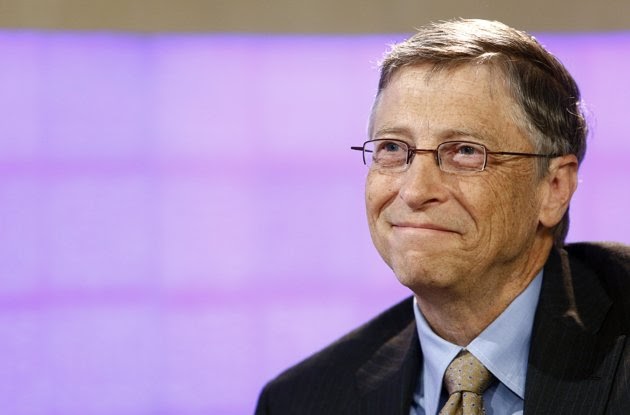
Getty Images/Peter Kramer - Bill Gates appears on NBC News' "Today" show -- (Photo by: Peter Kramer/NBC/NBC NewsWire)


..
 By Bree Fowler, The Associated Press


NEW YORK, N.Y. - Life is good for America's super wealthy.
Forbes on Monday released its annual list of the top 400 richest Americans. While most of the top names and rankings didn't change from a year ago, the majority of the elite club's members saw their fortunes grow over the past year, helped by strong stock and real estate markets.

"Basically, the mega rich are mega richer," said Forbes Senior Editor Kerry Dolan.

Dolan noted that list's minimum net income increased to a pre-financial crisis level of $1.3 billion, up from $1.1 billion in 2012, with 61 American billionaires not making the cut. "In some ways, it's harder to get on the list than it ever has been," she said.

Microsoft Corp. co-founder Bill Gates remains America's richest man, taking the top spot on the list for the 20th straight year, with a net worth of $72 billion, up from $66 billion a year ago.

Investor Warren Buffett, the head of Berkshire Hathaway Inc., posted another distant second place finish with $58.5 billion, but increased his net worth from $46 billion. Oracle Corp. co-founder Larry Ellison stayed third with $41 billion and was the only member of the top 10 whose net worth was unchanged from a year ago.

Brothers Charles and David Koch, co-owners of Koch Industries Inc., stay tied for fourth with $36 billion each, up from $31 billion in 2012.

Wal-Mart heirs Christy Walton, Jim Walton, Alice Walton and S. Robson Walton took the next four spots, with holdings ranging from $33.3 billion to $35.4 billion, all increasing from year-ago levels. New York City Mayor Michael Bloomberg, the founder of the eponymous financial information company, rounds out the top 10 with $31 billion, up from $25 billion.

According to Forbes, 273 members of the list are self-made billionaires, while 71 inherited their wealth and another 56 inherited at least some of it but are still growing it.

Facebook CEO Mark Zuckerberg returned to the list's top 20 after dropping out the year before. His net worth of $19 billion earned him the No. 20 spot.

Facebook co-founder Dustin Moskovitz also made the list, at No. 85,with a net worth of $5.2 billion. At age 29 and just a few days younger the Zuckerberg, Moskovitz ranks as the youngest member of the list.

On the flip side, the oldest person on the list is 98-year-old David Rockefeller Sr. at No. 193 with a net worth of $2.8 billion.

A total of 20 new people joined the rankings, including Richard Yuengling Jr. of Pennsylvania beer maker D.G. Yuengling & Son, who ranked at No. 371 with $1.4 billion.

Twenty-eight people dropped off the list, including six who died. Those now falling short of the cut include energy tycoon T. Boone Pickens at $950 million, Graham Weston of Rackspace Hosting Inc. at $920 million and Washington Redskins owner Dan Snyder at $1.2 billion.

A total of 48 women made the list including Hyatt Hotels heir Jennifer Pritzker at No. 327. Formerly known as James Pritzker, she's the list's first transgendered member.

According to Forbes, the 400 people on the annual list posted a combined net worth of $2 trillion, up from $1.7 trillion a year ago. That marks their highest combined value ever.

Meanwhile, the average net worth of the list's members rose to $5 billion, also the highest ever, up from $4.2 billion in 2012. Net worth grew for 314 members and fell for 30, Forbes said.

The increases aren't surprising, given that net worth for America's wealthiest people has risen in the years since the financial crisis, widening the gap between the exceptionally well-to-do and the rest of the country.

According to a study of Internal Revenue Service figures released last week, the top 1 per cent of U.S. earners collected 19.3 per cent of household income in 2012, their largest share in IRS figures going back a century.

U.S. income inequality has been growing for almost three decades. But until last year, the top 1 per cent's share of pre-tax income had not yet surpassed the 18.7 per cent it reached in 1927, according to the analysis done by economists at the University of California, Berkeley, the Paris School of Economics and Oxford University.

Some economists have speculated that the incomes of the wealthy might have surged in the past year, because they cashed in stock holdings to avoid higher capital gains taxes that kicked in in January.
___

The Forbes 400: http://www.forbes.com/forbes400

..

Thursday, July 25, 2013

Strange fish turns human in Ibadan


Residents of Gege in Ibadan South West Local Government area of Oyo State were shocked on Tuesday, when a fish bought by a middle aged woman, Mrs. Ramota Salawu, suddenly turned to half human.
Hundreds of residents struggled to see the miracle fish where it was placed inside water in a brown bucket at Akindele Compound, Gege , Ibadan, the home of Mrs. Salawu .
When The Nation visited the compound, the said miracle fish has long white hair. The face has resemblance of a baby, while the trunk is that of a fish.
While narrating her experience, Mrs. Salawu said “I went to where we usually buy fish at Kola Eleja , Oke Ado, Ibadan to buy fish. After I finished, I boarded Okada to my place to prepare the fish for sale. Before getting the fish out of the ice-pack, we need to use knife to remove them and use water to defreeze.
“I was shocked to see the frozen fish developed into a living being in the water, the description of which showed half human and half fish. I quickly called by father and some alfas to see the strange fish.”
The fish seller could not gather herself together as she was overwhelmed by what happened.
The father of the woman, a retired civil servant, Pa Rauf Salawu expressed bewilderment over the miracle fish, adding that he has never seen such a thing before.
He said,” It was around 11am, when I started hearing the voice of my daughter while I was resting on my bed. She was shouting and screaming, such that people in the compound were attracted. Then, I decided to check what the problem was. I took along my Quran and on getting there my daughter has gone to call Sheu , a Muslim leader in the neighbourhood .
I saw the strange fish inside water in the bucket. It was strange. How can a fish bought in the cold room developed into human? That I cannot fully explain.”
There was heavy presence of policemen from the Mapo Police Station to control the crowd and maintain peace and order.

Monday, June 24, 2013

Don’t underestimate Muhoozi, Museveni tells top commanders


It was in the last part of his speech to the UPDF High Command, but President Yoweri Museveni’s comments about his son, Brig. Muhoozi Kainerugaba, have become the talking point among the officers that The Independent has spoken to since.

On May 22, just a day before Museveni sweeping changes in the army top leadership, he convened a special meeting of the army’s topmost decision making body, the Army High Command, at State House Entebbe.

Museveni’s speech touched on many issues, including the role of young officers in the army, and the failures of then- Chief of Defence Forces, Gen. Aronda Nyakayirima, his then deputy, Lt. Gen. Ivan Koreta and former Air Force Commander, Lt.Gen. Jim Owoyesigire.

Brig. Muhoozi attended in his capacity as the commander of Special Forces.

Others in attendance were the Defence Minister and the two members of the original High Command as of January 26, 1986; Museveni’s younger brother, Gen. Salim Saleh, and Gen. Elly Tumwine. They `originals’ were six including Eriya Kategaya, the late prime minister, Matayo Kyaligonza who is ambassador to Burundi, and Gen. David Sejusa who is in exile.

The Chief of Defence forces, Gen. Katumba Wamala, his deputy, Lt. Gen. Charles Angina, all Service Commanders, the Chief of Staff, all Service Chiefs of Staff, all Chiefs of the Services of the Defence Forces, attended.

The High Command holds at least three annual meetings annually, but this was a special session.

Sources at the meeting told The Independent that it was clear that President Museveni sought to allay allegations that he was grooming his son, Muhoozi, to succeed him as president under the so-called `Muhoozi project’.

Gen. Sejusa, the erstwhile Coordinator Intelligence Services before he fled the country in April sparked controversy with a letter published in the media alleging a plot to assassinate army officers and politicians opposed to Muhoozi.

Sources told The Independent that apart from questioning why the military intelligence had not exposed “the subversive activities of Tinyefuza”, Museveni did not talk about Sejusa again.

However, he questioned the tendency of some officers not to use the “appropriate fora to voice opinions”. Our sources say he was understood to be referring to Gen. Sejusa.

“Do public statements provide any solution to any problem in the army?” Museveni asked, “If not, what are they for?”

Praising Muhoozi

He brought up the Muhoozi issue as he was concluding his speech.

“I cannot end this speech without talking about the issue of Muhoozi (Brig. Muhoozi Kainerugaba) since our enemies have made it a daily issue in the papers and the subversive activities of some individuals constipated with ambition and deceit,” Museveni said as he concluded his long speech.

“I am most pleased that Muhoozi has turned out to be a very serious officer, quiet and devoted to the building of the army,” Museveni told his commanders, “He has already helped us to build a Commando Force and Paratrooper Force which some of the earlier actors had either failed or refused to build.”

Museveni said the Commando Force, in partnership with elements of the Second Division, gave the ADF (Allied Democratic Forces) rebels such a decisive defeat in Semliki, western Uganda in 2007 that they have never returned to Uganda since.

In Mogadishu, Museveni went on; the commandoes have killed 192 enemies without losing any of their force.

Museveni said in all the years he has spent building the UPDF, only two people have written for him papers on Strategic and Army doctrine.

“One of them was Gen. Katumba (Wamala) when he was an instructor at Jinja,” Museveni said, “That is how I came to know him. Muhoozi has written for me several high quality papers of doctrine and strategy.”

Museveni said Muhoozi was the one who had exposed to him how the 47 Battalion deployed in the Democratic Republic of Congo to flush out the Lords Resistance (LRA) in 2008’s Operation Lightening Thunder, were eating only one meal a day. Muhoozi’s commandoes were part of this operation and that is how he came to find out, Museveni noted.

Indeed Museveni seemed not to be sure the problem had been solved for good. “Military intelligence has some gaps,” Museveni said, “why did they not detect the underfeeding of soldiers for instance? Has the underfeeding of soldiers stopped?”

A source told The Independent that members of the Reserve Fore were still suffering this problem.

Museveni added that Muhoozi is the one who advised the UPDF soldiers on the AMISOM mission in Mogadishu, Somalia, to use mouse-hole explosives in their fight against al-shabaab.

He told the High Command that before the Muhoozi intervention, the UPDF soldiers in Somalia were finding difficulty in uprooting the enemy because they were attacking through the narrow streets. Even when they changed tactics and started digging trenches, the enemy would hear them and run or attack them.

When Muhoozi visited, Museveni told the commanders, he advised them to use mouse-hole explosives that blast holes through walls. That way, the UPDF would make gains against the terrorists and hence the successes the army has registered in Somalia.

“To vilify, demonise, castigate, harangue in a demented way against such an officer is sickness in a metaphorical sense,” Museveni reportedly said, “If you have no objectivity to see value, then your leadership qualities are in question.

“Even if Muhoozi was a mediocre performer, it would be the duty of the army to defend its members as long as he has done no wrong or mistake.”

The Army High Command, according to the UPDF, is supposed to advise the President in emergency situations and on matters relating to national security or deployment of the Defence Forces and when the country is at war.

On Aronda, Koreta, Tumukunde

Without mentioning it, our sources said, Museveni used the meeting to prepare the UPDF leadership for the reshuffle he was set to announce the following morning.

In the reshuffle, Museveni removed Gen. Aronda Nyakairima and his deputy, Lt Gen. Ivan Koreta from army leadership and appointed Gen. Katumba and Maj. Gen. Angina to replace them. He appointed Gen. Aronda minister for Internal Affairs. Gen. Koreta was named ambassador for a yet to be named mission.

“While many Ugandans continue to speculate about why Museveni changed the UPDF leadership, for those who attended the meeting, they had got the answers that night even if they didn’t know that a reshuffle was looming,” our source said.

Museveni defended the appointment and promotion of young officers saying it was part of a strategy to attract new blood. He listed army officers that had attained top ranks at tender ages on the international scene and during the bush war in Luweero.

Museveni has been criticized for the apparent rapid promotion of his son, Brig. Muhoozi. However, his explanation, according to our sources appeared designed to show why he was shifting the leadership of the UPDF to young officers.

“The young and healthy people rescued this army and all should salute them,” Museveni said, “Therefore, those cadres who resent the political commissars we conscripted into command or the young commanders we recruited are `abashaija babi’ (bad men) as the Banyankole say.”

Museveni expressed frustration about personal indiscipline that had led to the death, due to sickness, of the older top commanders on the very dawn of the NRM’s capture of state power in 1986.

He said five nominees for a senior command training course in the USSR were found unfit for that course on health grounds and good commanders like Kamuntu and Katerega broke down because of the rigours of another course in Tanzania.

Museveni said as a result, they ended up sending political commissars who did not have combat experience for the trainings instead.

Ghosts resurface

At the meeting, Museveni categorised the UPDF’s challenges into two; hardware and software challenges.

Amongst the hardware challenges, Museveni listed the lack of a more capable air-defence system, suitable barracks for soldiers, a more capable marine force, a comprehensive repair and upgrade capacity for aircrafts, tanks and IFVs.

He said Uganda’s military industries need to be upgraded to manufacture the vital strategic elements the army needs so that it only buys from outside the other general requirements.

He said the welfare of the families of our comrades who died in the last 43 years needed to be extended beyond the free schooling up to A’ level which the army has been providing.

Then he embarked on the software issues which he described as “lingering negative tendencies”.

Of the seven he listed, our sources said, at least five appeared to be directed at the Aronda leadership. Museveni said the main two were failure to inspect troops and poor planning.

Museveni told the commanders that he had got a report; he would later reveal that it was from Muhoozi, that the 47 Battalion was eating only one meal just before the Garamba operation. The mission that was supposed to net LRA leader Joseph Kony was botched.

Museveni told the commanders that he told Gen. Aronda about it but later on got additional information that this was a wider problem—soldiers in DR Congo, Southern Sudan and Central African Republic (CAR) were all not getting all the food that had been released for them.

Museveni told the commanders that he also was told that “ghost soldiers” had resurfaced as the numbers of soldiers on the ground were far fewer than the payable strength. The phantom soldiers, used mainly by the army leadership to skim off millions of shillings in salaries and allowances, were still haunting the UPDF payroll. Our sources say Museveni was visibly angry about this development, when he confronted Aronda and then-Air Force Commander, Maj. Gen. Jim Owoyesigyire.

“How does such a situation come about?” Museveni asked.

Museveni also faulted the Aronda leadership of failing to “use collective solutions” to ensure that university going children of soldiers to get that education.

He said that he had written to Aronda about this—especially the need to streamline the army Savings and Credit Cooperative (SACCO) also known as Wazalendo to enable soldiers access credit.

Wazalendo is composed of UPDF personnel, their families, Reserve Forces and Staff of Ministry of Defence (MOD) according to the information on its website.

Under the SACCO, soldiers save 16 percent of their earnings and this pool is supposed to make it easy for them to access loans (credit) to enhance their individual welfare both socially and economically. By June 30, 2011, the SACCO boasted of 64,482 members since its inception in 2005.

But a source told The Independent that there were issues in managing the SACCO and the soldiers were not happy with it. Apparently top ranking officers were the ones accessing the SACCO money at the expense of their poor colleagues.

The biggest and most costly failure of the Aronda leadership, Museveni said, was poor or inadequate planning in the force.

Museveni told his commanders that he was very disappointed when after establishing a planning department and appointing Brig. Henry Tumukunde in charge of it, he heard that Tumukunde was disgruntled because planning was a “dry” department.

Museveni said that because of the weakness of the department, he had to intervene in petty issues like the need for enhanced pay for pilots and airforce mechanics.

“I do not even know whether the directives on that issue have been implemented,” he said, “I was forced to come in because I discovered that we will never develop an air-force if we continue failing to pay pilots what their colleagues are paid in the open market.”

Museveni said his biggest frustration was that poor planning caused the loss of the three choppers that crushed in Mt. Kenya enroute to Somalia.

He told the commanders that he had been against deploying the gunships to Somalia because Uganda had just attained a squadron force and he did not like the idea of scattering those scarce resources when enemies like the ADF were still swirling around Uganda.

Apparently, it is Aronda and Owoyesigyire that persuaded Museveni with prospects of making a lot of money by deploying the gunships involved.

“When eventually, I agreed, I did not know that operational planning in the Air-force was totally inefficient; no navigation charts, no emergency standing operating procedures,” Museveni said, “It was such a wastage!”

When the UPDF choppers crashed in August 2012, an angry Museveni took swipes at commanders whom he blamed of having a business mentality. At the time, no one could put a finger on these specific commanders but after the May 22 meeting, those who attended realised that beyond Owoyesigyire and his former Chief of Staff, Brigadier Moses Rwakitarate who were fired immediately, President Museveni also blamed Aronda for the chopper crashes.

Museveni said before Muhoozi advised them, the UPDF had failed to establish zonal forces to protect the areas they had captured from the enemy in Somalia. He narrated to the commanders that Aronda had travelled on a UN plane from Mogadishu to Baidoa.

“I asked Aronda how long it is from Mogadishu to Baidoa and he said two and a half hours,” Museveni narrated how he asked Aronda how the force could cover an area as big as from Entebbe to Kaabong without zonal forces.

On making this point, Museveni vowed in front of the commanders that he was going to overhaul the Somalia mission too. At the time, no one imagined that that overhaul would swallow Aronda as it did the next morning.


Tuesday, April 9, 2013

Uhuru inaugurated as Kenyan president


Kenya’s fourth president Uhuru Kenyatta is sworn into office by chief registrar Gladys Sholei (L) as his wife Margaret Kenyatta (R) looks on. The ceremony took place in Nairobi yesterday. PHOTO BY AFP


Kenya's new president, following his victory in March against Raila Odinga.

Dignitaries and tens of thousands of people witnessed the inauguration at a stadium in the capital, Nairobi.

Mr Odinga did not attend the ceremony after his attempt to overturn Mr Kenyatta's victory in court failed.

Mr Kenyatta and his deputy, William Ruto, face charges at the International Criminal Court relating to post-election violence five years ago.

They were on opposite sides at the time and both deny the accusations.

Sudanese President Omar al-Bashir, who faces an ICC arrest warrant over the conflict in Darfur, is not in Nairobi for the inauguration.

Mr Kenyatta is the son of Kenya's founding father, Jomo Kenyatta, and is heir to one of the largest fortunes in Kenya.

'Peace'


He served as deputy prime minister, minister for trade, and finance minister under outgoing President Mwai Kibaki.

The 51 year old will be Kenya's youngest president.

The crowd, waving Kenyan flags, burst into rapturous welcome as he took the oath of office.

Among the African leaders present for the inauguration were South Africa's Jacob Zuma, Nigeria's Goodluck Jonathan and Uganda's Yoweri Museveni.

Mr Odinga - the outgoing prime minister - is on holiday in South Africa, while other senior members of his Coalition for Reforms and Democracy (Cord) party have also stayed away to signal their opposition to Mr Kenyatta's presidency, correspondents say.

According to official results, Mr Kenyatta beat Mr Odinga by 50.07% to 43.28% in March, avoiding a run-off by just 8,100 votes.
Mr Odinga challenged the result, but said he would respect the Kenyan Supreme Court's ruling in Mr Kenyatta's favour.

After the ruling, Mr Kenyatta said his government would "work with and serve all Kenyans without any discrimination whatsoever".


"Above all, let us continue to pray for peace in our country," he said.

The election was Kenya's first after a disputed poll in 2007, which led to violence that left more than 1,200 people dead.

Mr Kenyatta is due to appear at the ICC for his trial in The Hague later this year, accused of crimes against humanity. He denies the charges.

Kenya is a party to the Rome Statute, the treaty which established the ICC in 2002.

But like most African countries, it has refused to enforce the ICC warrant for Mr Bashir's arrest.
Earlier, Kenyan government spokesman Muthui Kariuki told the BBC that Mr Bashir had been invited and would not be arrested if he accepted the invitation.


After Mr Bashir visited Kenya in 2010, a Kenyan court ruled that the government must arrest him if he returned, in line with its international obligations under the Rome Statute.

The government is appealing against the ruling.

Museveni attacks ICC at Uhuru’s swearing-in

Kampala


President Museveni yesterday lashed out at the International Criminal Court (ICC), saying it has been “grabbed by a bunch of self seekers and shallow minded people whose interests is to mint revenge on those who hold opposing views.”

Without specifying the “ICC grabbers, self seekers and shallow minded people”, President Museveni said the election of Mr Uhuru Kenyatta and his deputy, Mr William Ruto, is a reminder to those using the ICC to blackmail others (African leaders) for selfish reasons that Africa is not a haven for them.

The President was among dignitaries attending President Kenyatta’s inauguration ceremony at Moi International Sports Centre in Nairobi yesterday. “I want to salute the Kenyan voters on one other issue—the rejection of the blackmail by the International Criminal Court (ICC) and those who seek to abuse this institution for their own agenda,” Mr Museveni said. He continued: “I was one of those that supported the ICC because I abhor impunity. However, the usually opinionated and arrogant actors using their careless analysis have distorted the purpose of that institution

They are now using it to install leaders of their choice in Africa and eliminate the ones they do not like.”

According to President Museveni, what happened in Kenyan election in 2007, where more than 1,000 people were killed, was not just regrettable but must be condemned. However, in his view, the external legalistic process happening at Hague is not the solution to the electoral violence or the African problems.

The President’s advice

He said: “Events of this nature first and most importantly, need an ideological solution by discerning why they happened. Why did inter-community violence occur? Was it for genuine or false reasons?” He added that instead of a thorough and thoughtful process, individuals are engaged in legal gymnastics!

Citing Uganda’s case, he said between 1966 and 1986, the country lost about 800,000 people, but it was not the ICC or the UN that helped the country deal with the sad chapter of the country’s history. “We only referred Joseph Kony of LRA to the ICC because he was operating outside Uganda. Otherwise, we would have handled him ourselves,” said President Museveni.

iladu@ug.nationmedia.com


Thursday, February 7, 2013

Shokri Belaid assassination in Tunisia

Shokri Belaid assassination in Tunisia, the Secretary-General of the National Democratic Party of Tunisia video and photos


Shokri Belaid a Political, secular and leftist opponent to the policies of the Government of the Tunisian Renaissance Movement


who Killed Belaid ? And how he was assassinated ?


Shokri Belaid killed by two bullets in the neck and head in front of his house on the morning of Wednesday 6-2-2013

The identity of the perpetrators have not been identified so far and a Video was published on the moment of Shokri Belaid assassination and the arrival of an ambulance to take him after he was assassinated

In reaction to the assassination of Belaid ,Hamadi Jebali, head of the Tunisian government said that he will spare no effort to find out the perpetrators and arrest them as soon as possible

Video after the moment of the assassination of Shokri Belaid and the arrival of an ambulance to take him - YouTube


Belaid warned of the Renaissance Party ( Ennahda Movement ) and the assassination of political opponents a few hours before his death on Nessma tv channel

he said that Renaissance Party gives the green light for the assassination of political opponents


a photo of Shokri Belaid, who was assassinated in Tunisia 6-2-2013


Thursday, November 22, 2012

This is the turning point for Uganda - Muntu


At 6:36pm yesterday, the FDC Electoral Commission chairperson, Mr Dan Mugarura, announced that Maj. Gen. Muntu had returned 393 votes (50.64 per cent), defeating Leader of the Opposition in Parliament, Mr Nathan Nandala Mafabi, who got 361 votes (46.392 per cent).


Tororo County MP Geoffrey Ekanya came third with 17 votes (2.91 per cent) in the three-horse race to lead the biggest opposition party in the country.

Gen Muntu’s win marked the end of a tense 90 days that saw the three candidates traverse the country to canvass for votes in a campaign which has tested the FDC’s ability to stay united.

The party rules provide that a winner would be decided if one candidate gathered 50 per cent plus one vote.

A total of 776 votes were cast as the party marked a transition from founding president, Dr Kizza Besigye, who has thrice run against President Museveni in bitterly fought national polls. Dr Besigye has consistently rejected the outcome of his contests with Mr Museveni in 2001, 2006 and 2011 as having been rigged in favour of the incumbent.

Jubilation

Delegates, who had convened at Namboole stadium erupted in jubilation as Gen. Muntu was lifted shoulder high by supporters.

The Mafabi camp was clearly devastated, with some of his supporters collapsing.

Mr Mafabi, however, promised to work with the winner and asked members to be accountable to the party. Proceedings at Namboole were not without some drama. At polling station number 7, controversy brewed, forcing a recount of votes.

Mr Toterebuka Bamwenda, the FDC deputy spokesperson, and a member of the Elect-Nandala task force, said his team would petition the FDC National Election Tribunal over “multiple voting”.

“Alice Alaso voted seven times and Francis Epetait voted three times,” Mr Bamwenda said. Ms Alaso, who is the party secretary general, however, said she would reply after reading the promised petition.

Tension, excitement and intrigue characterised yesterday’s election as delegates drawn from Uganda’s 80 districts as at 2010 struggled to marshal last minute support for their candidates.

Police was heavily deployed in and around the stadium complex as voting commenced at 2pm. Earlier, at 11am, rumours of voter bribery rippled through the conference. A lady identified as Ms Anita Among was reportedly caught distributing money. No action was taken by party security though. Other unknown persons were seen holding tags written on “Namboole staff” although the stadium management could not positively identify them as part of their staff.
At the main gates, there were skirmishes as police fought off people without accreditation. Most claimed to be delegates who had been disenfranchised. Several people were arrested on suspicion that they wanted to take advantage of the commotion to commit crimes.


Dr Besigye had stayed in the shadows throughout the campaign, refusing to take sides in a process which sometimes threatened to come undone by mudslinging, sectarian tendencies and accusations of voter manipulations.

Yesterday, he told delegates he was leaving the party leadership “to concentrate on the struggle to liberate Uganda.”

Dr Besigye leaves the party leadership just two years shy of the end of his presidency, which would have ended in 2014.

“Once I have handed over the party leadership today, I will concentrate on the struggle to liberate Uganda,” he said.

This was yet the first hint Dr Besigye was giving that he will again offer himself for election when the country goes to the polls in 2016. The FDC constitution allows any party member, popularly elected, to stand as party flag bearer in national elections.

“I will be available to the new party leadership and to the party if called upon to do so. I am not going to the tall grasses,” Dr Besigye added.
“Last month I completed seven years as leader of the FDC. I felt going beyond seven years would be disgraceful,” he said. Dr Besigye also outlined five principles which he said the new party president should adopt.

\“The new leader must devise new methods of raising money for the party, promoting the party’s ideology, building the party’s grass-root support and leadership,” Dr Besigye said.

Tensions reached fever-pitch when the candidates took to the podium to make a final case for support.

There had also been debate on whether party Ms Alaso should be allowed to deliver a status report on the party’s affairs.

Ms Alaso was later granted seven minutes to deliver the party’s status report.

Candidates resorted to catchy names. Gen. Muntu described himself as a “fearless patriot” while Mr Mafabi called himself a “villager”. Mr Ekanya chose to describe himself as a “musician and a dancer.”

Taking to the podium first, the “patriot” lashed at critics who suggest that he is “an NRM mole and a coward”. “Those who say I am an NRM mole, you hurt me deeply. Everything I have done has been to promote FDC,” he moved.

“You call me a coward, a man who led an army of 100,000 men and seven factions and left it intact with no factions?” he added.

He asked delegates not to vote for him if they sympathise with him.

“I don’t need your sympathies. Twice, I have handled defeat and you have seen how I have behaved. Now, trust me with victory and I will not disappoint you,” he said.

“I have been specifically designed to fit in the strategy of FDC, to liberate this country by hastening the exit of this regime,” the former army boss, added.

“The villager” was next, describing himself as a “general” in mobilisation. “FDC needs hands-on leaders. If I managed the Bugisu Corporative Union to its present success, what more can I do for this party and country,” Mr Mafabi said.

“Good party structures in the grassroots will automatically campaign for the party. I have the capacity as a villager to reach the grassroots. I have done it time and again,” he added.

Mr Ekanya, the “dancer”, told the gathered faithful that time had come to change the manner in which FDC affairs are run.

He castigated the trend where the party president has automatically gone on to be the party’s flag bearer. “A party in the opposition cannot behave like a party in power. We must change internally before we can change this country otherwise we are doomed,” he said.

“When the time came to create the necessary music to kick President Museveni out of power, few showed up. It is time for the men and women of FDC to stand up and be counted,” Mr Ekanya added

REACTIONS TO VOTE


Mr Joachim Buwembo, Journalist. Congratulations to Gen. Mugisha Muntu, a man of privileged background who could have had it easy and comfortable all the way from his campus days ... through the current administration, but chose to always be on the side of the people...


Ms Betty Akello [Farmer]


The election was good and well oraganised and I did not find anything wrong with it that might affect the credibility of the winner.

Sheik Sinan Kagwa [Businessman]

On the Ugandan level, it was a fairly managed event. What the delegates had not understood was the provision of MPs voting for others [by proxy] which was explained to us by the electoral commission later.

Mr Habib Kasolo [Businessman]. I came to vote but when it came to elections time, MPs like Alaso, Nabilah and Epetait were voting more than once which made me very disturbed.

Ms Naiga Yudaya [Salon attendant].

The process was not going on badly until we learnt that the secretary general had voted more than once which might spoil our party as we have been trying to set an example.

Ms Nassuna Nulu [Farmer]

I didn’t find any major problems with the process that would affect the results.

By Solomon Arinaitwe
The making of the new FDC party president


Maj. Gen. Mugisha Muntu was born on January 1, 1958.

He studied Political Science at Makerere University. He served as the Army Commander from 1989 until 1998.

Muntu served served in the army at a time when, according to him, many “excited army officers” would keep sacks full of money in their offices.

There was “no” accounting system. He is credited for putting a stop to this and for not having abused his office to amass wealth.

A commendation would have been forthcoming, but for the 1995 Atiak massacre of 200 Ugandans allegedly by the Lord’s Resistance Army and for the 1998 killing of 80 students of Kichwamba Technical Institute by the Allied Democratic Force(s).

So President Museveni allegedly sacked him in 1998 when he (Muntu) was on leave.

Muntu later joined the opposition after falling out with the NRM over corruption and other forms of misrule. He also saw that Ugandans were now more divided by tribe and region than they have ever been – a consequence of President Museveni’s politics of cronyism.


Thursday, November 8, 2012

Britain and Ireland suspend aid to Uganda after 10 million pounds missing funds ends up in Prime Minister's Acount.


Up to £10 million of foreign aid was transferred to Patrick Amama Mbabazi's private account
The aid money was a joint gift from Ireland, Norway, Denmark and Sweden
Britain has joined Ireland in suspending all aid payments to Uganda

By Sam Greenhill and Daniel Martin

Millions of pounds in foreign aid to Uganda have been funnelled into private bank accounts of workers in its prime minister’s office.

The money was meant to have been spent on helping the needy in the poverty-ravaged African nation.

But instead the 12million euros (£10million) – a joint gift from Ireland, Norway, Denmark and Sweden – somehow wound up in accounts belonging to aides of prime minister Patrick Amama Mbabazi.


'Missing money': Britan and Ireland have frozen all aid payments after £10 million meant to help the Ugandan population ended up in accounts belonging to staff of Prime Minister Patrick Amama Mbabazi

No British money was taken but last night Whitehall officials said they had taken the precaution of suspending British aid payments of £4million-a-year to Mr Mbabazi’s office.

In total, Britain is sending £98million this year to Uganda, most of which will continue.

More...Hungary 'to offer wealthy foreigners citizenship in return for investment'

Stop giving millions in aid to richer countries like China and India, says ex-UN chief Kofi Anna
Palestinian prisoners are handed millions in British aid with some being paid more than average UK worker

The apparent fraud was discovered when the Irish government was told by Ugandan auditors that the 12million euros had gone ‘missing’.

The sum – of which Ireland’s contribution was 4million euros (£3.2million) – was supposed to have helped pay for a ‘peace recovery and development programme’ in northern Uganda after decades of conflict and devastation.

Ireland immediately halted further payments to Uganda pending investigation.

A political storm is now raging in Dublin, with Irish foreign minister Eamon Gilmore branding the apparent theft ‘intolerable’.


'Intolerable': Irish Foreign Minister Eamon Gilmore, seen here at the Irish Labour party conference, announced a suspension of all Irish aid money to Uganda
He announced there would be no more money for Uganda ‘unless it is clear Irish money is being spent for the purpose for which it was allocated’.

The Irish ambassador in Uganda, Anne Webster, has met government officials to demand the money be repaid.

A Department for International Development spokesman said: ‘We take these allegations extremely seriously and have already suspended UK aid to the Office of the Ugandan Prime Minister. We have set up an independent audit to investigate alleged fraud.’

A DfID source said: ‘Aid to the office of the Prime Minister is entirely separate from our general budget support to the Ugandan government.

‘If money has been misused, we will expect immediate repayment and will take all necessary action to protect our funds.’


Previous fraud: British aid money helped buy a £30 million Gulfstream jet for Ugandan president Yoweri Museveni, it was revealed last year
Read more: http://www.dailymail.co.uk/news/article-2225443/Brit
Previous fraud: British aid money helped buy a £30 million Gulfstream jet for Ugandan president Yoweri Museveni, it was revealed last year
Mr Mbabazi has publicly apologised to Ireland. He insisted: ‘I didn’t even know. No money was ever paid to me and I never handle money.

‘As the prime minister I don’t handle money of government at all, ever.’


Critique: Peter Bone, Tory MP for Wellingborough, said aid should have been stopped sooner

 He pledged prosecutions and said two senior officials had been charged – one of whom is the chief accountant –and 17 suspended without pay while the investigation continues.


Critique: Peter Bone, Tory MP for Wellingborough, said aid should have been stopped sooner

The apparent fraud was uncovered by Uganda’s own auditors.

Mr Mbabazi maintained that, although the missing money was discovered in private bank accounts, not all of it was ‘misappropriated’ but merely ‘irregularly managed’.

Last year it was revealed British aid money was used to buy a £30million Gulfstream jet for Uganda’s president, Yoweri Museveni. The autocratic 67-year-old leader – who was criticised after he launched a violent crackdown against democracy campaigners – bought the plane while millions of his countrymen struggled to feed themselves.

The latest revelation will reignite the row over British families being asked to fork out higher taxes to pay for aid.

Peter Bone, Tory MP for Wellingborough, said: ‘People in my constituency simply do not understand why we are giving money desperately needed at home to a corrupt regime.

‘It’s good DfID have taken action but they should have done their checks much, much earlier.

‘Uganda is not the only corrupt regime out there. I’m afraid to say it is largely endemic with some of our overseas aid.’

It was recently revealed Britain’s aid budget is rising so fast the Tories will enter the next election spending more on international development, which is immune from austerity cuts, than on the police.

Read more: http://www.dailymail.co.uk/news/article-2225443/Britain-Ireland-suspend-aid-Uganda-10m-funding-ends-Prime-Ministers-account.html#ixzz2Bh52ChqH

Follow us: @MailOnline on Twitter
DailyMail on Facebook

Sunday, September 30, 2012

Paul Ryan on tax plan: ‘It would take me too long to go through all the math’


Paul Ryan (Scott Wong/Getty Images)

 Paul Ryan says "it would take me too long to go through all the math" involved in the tax plan he and Mitt Romney are proposing.


The Republican vice presidential nominee said on "Fox News Sunday" that their plan--a 20 percent across-the-board income tax cut--would focus on deductions and closing tax loopholes for the rich, but declined to offer specifics.

The Obama campaign seized on Ryan's comments, firing off this response:

Romney has promised $5 trillion in tax cuts skewed toward millionaires and billionaires, but refused to say how he'd pay for them without raising taxes on the middle class or exploding the deficit. He's promised to repeal ObamaCare, but refused to say what he'd replace it with to protect the 129 million Americans with pre-existing conditions. He's promised to repeal Wall Street reform, but refused to say what he'd replace it with so that big banks aren't writing their own rules again.

But New Jersey Gov. Chris Christie defended the pair's tax plan on Sunday's "Meet The Press."

[Related: Chris Christie: Wednesday night's debate is 'the restart of this campaign']

"Governor Romney has a vision for the direction of this country," Christie said. "He's not an accountant. He's not going to go line by line, as much as you'd like him to do, through the budget."

Christie then pivoted to President Obama. "Let's hold the president to the same standard and criticize him as well," Christie said. "How's he going to create a million new manufacturing jobs? He hasn't told anybody the specifics of that. How's he going to reduce $4 trillion in debt? We're still waiting to hear what he thinks about Simpson-Bowles, which he commissioned. I mean, he's been the president, and hasn't given us specifics. So let's be fair here."

Ryan admitted the campaign has made several "missteps," including Mitt Romney's controversial "47 percent" comments about President Obama's core supporters. On Sunday, Ryan called those comments "inarticulate" and lacking "eloquence."

"Mitt acknowledges himself that was an inarticulate way of describing how we're worried that in a stagnant Obama economy more people have become dependent on government because they have no economic opportunity," said Ryan, chairman of the House Budget Committee. "It was an inarticulate way to describe what we're trying to do to create prosperity and upward mobility, and reduce dependency by getting people off welfare back to work."

Monday, September 10, 2012

Turbulent Somalia gets new president in vote for change


Members of parliament overwhelmingly elected political newcomer Hassan Sheikh Mohamud as president of Somalia on Monday, a result hailed by supporters as a vote for change in the war-ravaged country.


Bursts of celebratory gunfire crackled through the streets of the capital, Mogadishu, after the first vote of its kind in decades in Somalia drew to a close.

Mohamud won in a secret ballot with 190 votes, against 79 lawmakers voting for Ahmed.

"I congratulate all Somalis. The people are taking a new direction. You are now ending the difficult path and taking a new one," Mohamud said to a cheering crowd of well-wishers.

Although Mohamud is a relatively new face in Somali politics, the one-time academic will be confronted by old problems: acrimonious clan politics, rampant corruption, maritime piracy and a stubborn Islamist insurgency.

Mohamud, seen as a moderate, unexpectedly defeated incumbent President Sheikh Sharif Ahmed after two of the four candidates who made it to the second round of voting dropped out.

One of them, outgoing Prime Minister Abdiweli Mohamed Ali, who threw his weight behind Mohamud, said the result heralded a new era for Somali politics.

"Somalia voted for change," Ali told Reuters, adding it was too early to say whether he would take part in the next administration.

Somalia has lacked an effective central government since the outbreak of civil war in 1991.

The capital, however, which until last year witnessed street battles between al Qaeda-linked al Shabaab militants and African soldiers, is now a vibrant city where reconstructed houses are
slowly replacing bullet-riddled structures.


Monday's vote was seen as a culmination of a regionally brokered, U.N.-backed roadmap to end that conflict, during which tens of thousands of people were killed and many more fled.

Despite being on the back foot, the militants still control swathes of southern and central Somalia, while pirates, regional administrations and local militia group also vie for control of chunks of the mostly lawless Horn of Africa country.

"SAFE PAIR OF HANDS"

The outgoing president conceded defeat after onlookers in the hall where the vote was held spontaneously stood up and sang the national anthem.

Attention will now focus on whether all of Somalia's rival clans respect the result, or whether disgruntled factions will seek to destabilize the next government.

"(The) elected president must cope with security first, then the reconstruction of social infrastructure, resettling the numerous (refugees) around the country and the liberation of the rest of the country from al Shabaab," student Bashir Ali Abdikadir said.

Mohamud will also have to tackle Somalia's reputation as the most corrupt country in the world.

In July, a U.N. Somalia monitoring group report said it had found that out of every $10 in revenue raised between 2009-2010 $7 had never made it into state coffers.
A U.N. official who was present at the vote on Monday described Mohamud as "progressive and a safe pair of hands".


Residents said bursts of celebratory gunfire rang out in several cities across central and southern Somalia.

"A supported change is always positive," Mohamud Farah, a spokesman for government forces based in the former rebel stronghold of Afmadow in southern Somalia, told Reuters.

Jabril Ibrahim Abdulle, director of the Somali think-tank Centre of Research and Dialogue, where Mohamud worked for eight years, said the result highlighted Ahmed's failure to quash the festering Islamist insurgency and improve living standards.

"He is benefiting from the fallout over Ahmed. This vote shows that the Somali people were yearning for change," Abdulle said. "His biggest challenge will be the expectations of the people."

MANIPULATE

Touching a Koran with his right hand, Mohamud was sworn in as president within minutes of his poll victory at a crowded hall in Mogadishu's police academy.

As president, he will head the executive while the speaker of parliament is considered the most powerful politician and steps in if the president is unable to fulfil his duties.

Mohamud graduated from the Somali National University in 1981 before obtaining a master's degree in education from India's Bhopal University in 1988.


During the early years of Somalia's civil conflict, he worked for the U.N. children's agency, UNICEF.

In 1999, the fluent English speaker co-founded the Somali Institute of Management and Administration Development in Mogadishu, which later became Simad University, and served as its dean until 2010.

In 2011, he founded the Peace and Development Party.

The selection of Somalia's new lawmakers, whose first real task was to elect a new president, was marred by allegations of bribery and intimidation designed to manipulate Monday's vote.

Even so, many Somalis were elated their country was holding an election of sorts.

"It's something we have to witness and be a part of, even if we're not voting. We've been through a very difficult labor and we're finally giving birth," said Najmah Ahmed Abdi, who runs a Somali youth forum.

"The (lawmakers) have a momentous responsibility on their shoulders. Tomorrow will be like when U.S. President Barack Obama was elected. We hope we get our own Obama."

(Additional reporting by Mohamed Ahmed and Abdi Sheikh; Writing by Yara Bayoumy and Richard Lough; Editing by Alison Williams and Michael Roddy)


Toys & Games

Play Suduku.